E-commerceOnline ShopsCost of websitesIT costs and budgetingMaintenance and development of systemsHosting and Infrastructure12 min czas czytania14 567 znaków2399 słów
Ecommerce Website Cost: Subscriptions, Fees, Setup and Monthly Costs of an Online Store
Ecommerce website cost in practice: Shopify, PrestaShop and Ecwid subscriptions, payment fees, and how to work out your own monthly TCO.

Redakcja Digital VantageYour Partner in Business, Digital Vantage Team · Digital Vantage team is a group of experienced professionals combining expertise in web development, software engineering, DevOps, UX/UI design and digital marketing. Together we carry out projects from concept to implementation - websites, e-commerce stores, dedicated applications and digital strategies.
Our team combines years of experience from technology corporations with the flexibility and immediacy of working in a smaller, close-knit structure. We work in agile methodologies, focus on transparent communication and treat each project as if it were our own business.
The strength of the team is the diversity of perspectives - from systems architecture and infrastructure, frontend and design, to SEO and content marketing strategy. As a result, the client receives a cohesive solution where technology, aesthetics and business goals go hand in hand.
Publikacja
Aktualizacja
How much does an online store cost? Ecommerce website cost comes as two separate bills: the one you pay once to get the store running, and the one that comes back every month for as long as it operates. The platform subscription is only one line item on that second bill, and not necessarily the biggest one.
In this article we compare prices from platform and payment-gateway price lists read on 30 September 2026, and show how to work out your own monthly cost. Every figure carries a source and a date. Price lists change often, so check the current version at the link before you decide.
Two bills: setup cost and monthly cost
Setup cost is everything you pay once: configuring the platform or paying a contractor to build it, a template or a custom design, integrations with payments, couriers and your invoicing system, importing products, and activation fees from payment gateways.
Monthly cost is the sum of the bills that keep coming back: the subscription or hosting, paid apps and plugins, payment-processing fees, shipping and returns, marketing, technical upkeep, and people's time. The whole thing is called TCO (Total Cost of Ownership).
Why does the subscription alone tell you so little? Because platforms charge in different places. One has a higher subscription but takes nothing per order. Another has a cheap subscription and a flat fee per order. A third adds a percentage on top if you don't use its own payment processor. At a handful of orders a month the difference is negligible; at a few hundred, it can outweigh the subscription itself. That's why the rest of this article compares not just plan prices, but what's included in them, and what gets added per transaction.
If you're still choosing a model, see the ecommerce platform comparison, and for the launch itself, how to start an online store.
SaaS subscriptions, per the price lists read 30.09.2026
A SaaS platform is a store on a subscription: the vendor keeps the servers running, patches the software and is responsible for platform security, and you pay monthly or yearly. The trade-off — what you gain and what you hand to the vendor — is covered generally in our guide to SaaS. Below are the vendors' own published prices, read 30.09.2026.
Shopify
The Irish Shopify price list (EUR shown) gives: Basic €32/month billed monthly, or €24/month billed yearly; Grow €92/€69; Advanced €384/€289; Plus "starts at €2,100/month". The page doesn't say whether these include VAT. Trial: 3 days free, then €1/month for 3 months.
The subscription includes hosting, an SSL certificate and an unlimited product catalogue; Shopify doesn't charge a setup fee. What's billed separately: apps, premium themes, and Shopify Payments — on Basic, a standard online card costs 2% + €0.25; Amex and international cards 3.1% + €0.25; Klarna 4.99% + €0.35 (all Shopify Payments rates are listed excl. VAT). If you connect a different processor instead of Shopify Payments, Shopify adds its own transaction fee on top: 2% on Basic, 1% on Grow, 0.6% on Advanced, 0.2% on Plus (third-party gateway fees).
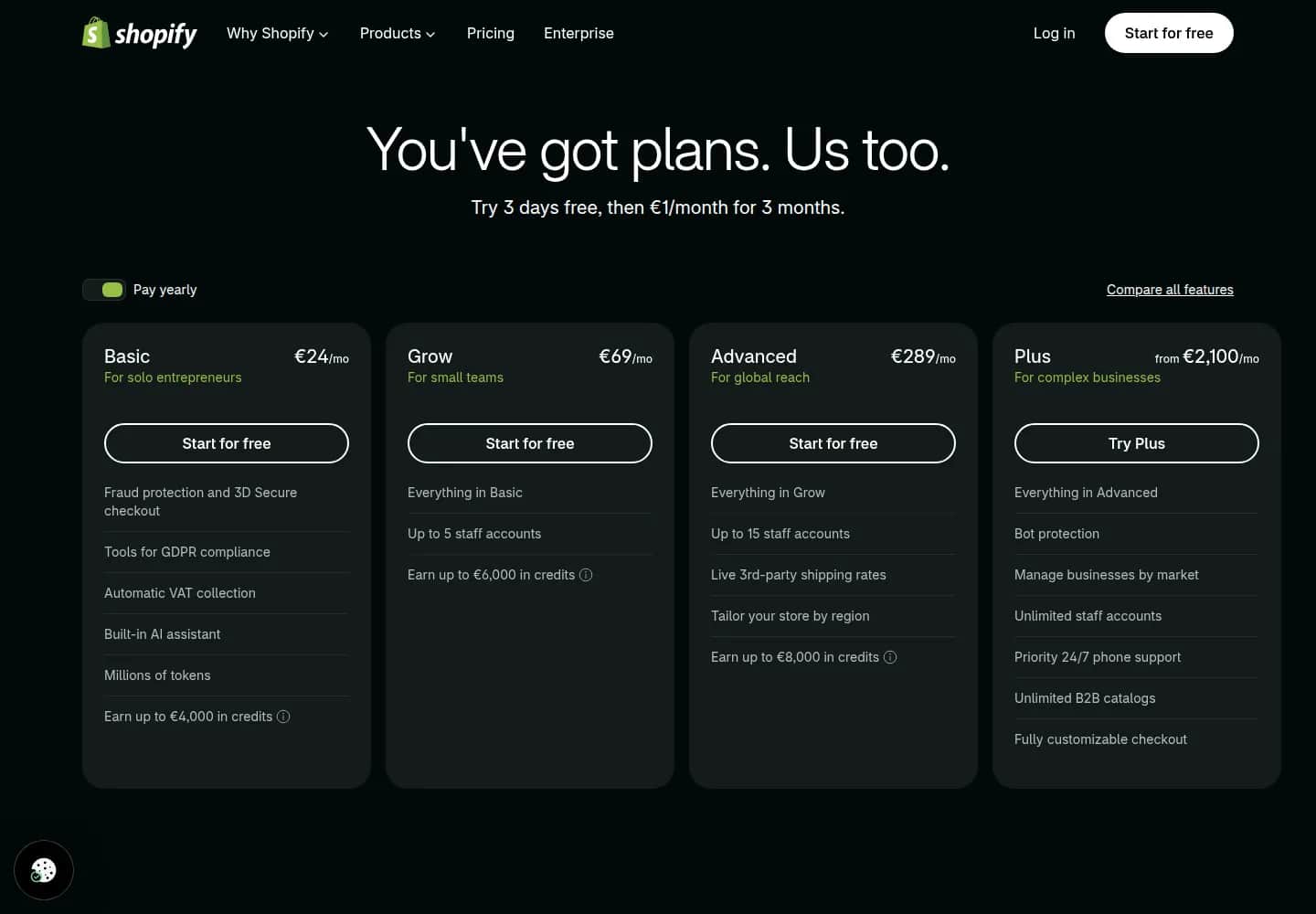
Shopify's Irish price list, billed yearly
shopify.com/ie/pricing, screenshot of 30.09.2026
PrestaShop Hosted
PrestaShop's open-source Classic edition is a free download. Its hosted plan, PrestaShop Hosted, costs €29/month with no commitment, or €24/month billed annually (€290/year), excl. VAT, with a 14-day trial and 50 GB of Gandi hosting included.
Ecwid
Ecwid no longer has a free plan. Billed monthly / annually: Venture €35/€29, Business €65/€49, Unlimited €149/€119; a "Starter" tier is listed at €5/month. Prices exclude tax, and Ecwid says it charges no setup or transaction fees on any plan.
Shopware
Shopware has a free Community Edition, then jumps straight to a mid-market tier: Rise "from €600/month excl. VAT", Evolve "from €2,400/month excl. VAT", and a custom Beyond plan. This is a different weight class from the other three, priced "based on your gross merchandise value (GMV) and further individual factors".
SaaS platform subscriptions — price from, per the lists read 30.09.2026
Shopify Ireland, PrestaShop Hosted, Ecwid, Shopware pricing pages, read 30.09.2026
What's in the subscription, and what you pay separately
Across SaaS platforms, the subscription generally covers hosting, software updates and an SSL certificate. You usually pay separately for:
- payments — the gateway's own fee, plus a third-party-gateway surcharge on some platforms (Shopify);
- apps and themes — usually from the platform's own marketplace;
- a higher plan — once you cross a product, order or feature limit.
It's also worth knowing what uptime commitment a vendor makes and what happens if the store goes down — that's the subject of a service-level agreement (SLA).
Open source: WooCommerce and PrestaShop — free code, everything else billed
WooCommerce and PrestaShop are open-source software: you download the code without a licence fee, and nobody takes a cut of your sales. You pay for everything around it.
WooCommerce describes itself as "the free, open-source ecommerce platform for WordPress." Its own pricing page gives estimates in USD: hosting $25–350 a month for most stores, extensions $29–299 a year each — no platform fees, no revenue share. An example extension, WooCommerce Subscriptions, costs $279/year.
PrestaShop in its self-hosted, open-source form is free. Its hosted, subscription version is the PrestaShop Hosted plan covered above.
Beyond hosting and extensions, open source carries two cost lines no vendor price list shows: implementation (configuration, template, integrations — see the implementation section below), and updates and upkeep — the engine, plugins and modules need patching, testing after patching, and securing. A SaaS vendor does this inside the subscription; in open source, you do it yourself or pay a contractor for it every month.
Payment gateways — standard rates
Whatever the platform, every online payment costs something. Standard published rates, read 30.09.2026:
- [Stripe](https://stripe.com/ie/pricing): standard European Economic Area cards 1.5% + €0.25; premium EEA cards 2.8% + €0.25; UK cards 2.5% + €0.25; international cards 3.15% + €0.25 plus 2% for currency conversion; each dispute you receive costs €20, plus another €20 if you contest it and lose.
- [Mollie](https://www.mollie.com/en/pricing): EEA consumer cards 1.80% + €0.25; EEA commercial cards and Amex 2.90% + €0.25; non-EEA cards 3.25% + €0.25; local methods (iDEAL\|Wero, Bancontact, BLIK, TWINT) priced separately.
- [Adyen](https://www.adyen.com/pricing): "For each transaction, we charge a fixed processing fee + a fee determined by the payment method" (Interchange++ plus a markup for cards) — no setup or monthly fee, but also no single published flat EUR rate; request a quote and rely on the model, not a number.
- PayPal has no single EU rate — fees differ by country. Ireland: "All Other Commercial Transactions" 3.40% + €0.35; Germany: PayPal Checkout 2.99% + €0.39 (German-language page). Always check the merchant's own country page before you quote a rate.
The fixed part of a fee (€0.25–€0.39) matters most on cheap orders: on a €30 order, Stripe's €0.25 is under 1% of the sale, but on a €5 order it's already 5%, before the percentage applies. EU law also caps the interchange fee on consumer card transactions at 0.2% for debit and 0.3% for credit cards (Regulation (EU) 2015/751), bans surcharges on cards whose interchange is regulated this way (PSD2, Art. 62(4)), and sets the strong-authentication exemption for online cards at €30 per transaction (RTS (EU) 2018/389, Art. 16). More on choosing payment methods and delivery is in payments and logistics.
Implementation and setup — get quotes, not averages
We know of no EU-wide, publicly available benchmark of online-store build costs, so we don't quote one. Build costs depend on your scope and on who does the work. For an implementation-cost estimate, use the subscription and gateway figures above as your baseline, and get two or three comparable quotes from agencies or freelancers for your own scope.
If you're considering a store in a headless architecture — a separate front end connected over an API — that's its own cost category, covered in headless vs. classic store.
Monthly store costs (TCO) — how to work them out
The monthly cost of running a store is the sum of small, recurring bills that grow with sales. The simplest approach is to lay them out once across seven categories, then update them every month. We don't give "typical" figures for whole scenarios here — they depend on your category, basket size and order volume. What follows is what to write down and how to calculate it.
Separate one-off costs from recurring ones first
One-off costs are the launch or a migration: a template or design, configuring tax and shipping, integrations, importing products, training your team. Recurring costs are everything that comes back every month. Mixing the two leads to a familiar problem: the store has money for launch, but no reserve for the fixed bills that show up a few months in.
1. Platform and technology
The SaaS subscription or hosting, paid apps and plugins, the domain, monitoring. On SaaS, check the plan's limits — products, orders, admin accounts — since crossing them moves you to a higher tier. On open source, add hosting; on a headless store, add front-end hosting and a test environment too.
Once a quarter, review the list of add-ons: what each one costs, what it does, whether it duplicates another one, and whether it slows the store down. Every app is another script loaded in the customer's browser — a cost, and also a speed problem.
2. Payments
What matters here is the effective payment fee — how much you actually hand to processors relative to sales:
> effective fee = (total processing fees + chargeback costs + payment-refund costs) ÷ online payment volume
Add the flat per-transaction fee, payout fees, any third-party-gateway surcharge the platform charges, and the cost of chargebacks (Stripe, for instance, charges €20 for every dispute received) on top of the headline rate. Check your contract on whether the processor refunds its fee on a returned order — if not, every return costs you the processing fee on a sale that no longer exists.
3. Delivery and returns
Shipping cost isn't one rate but a matrix: size, weight, zone, surcharges for odd-shaped parcels. On top of that, returns — a label, inspecting the goods, repackaging, staff time — and, if you use one, a third-party fulfilment warehouse that charges for receiving, storing and picking. One metric rolls all of it up:
> logistics cost per order = (shipping + returns + fulfilment + packaging + operational labour) ÷ orders fulfilled
Compare it against your average order value and your free-delivery threshold — it immediately shows whether that threshold is set sensibly.
4. Marketing and content
Ads, email and SMS tools, a product-feed tool, photos and copy, translations. This is spend meant to produce revenue, so measure it against sales, not just as a number: what it costs to acquire a customer, and whether you're still making money on that customer once returns are deducted.
5. Technical upkeep and security
Updates, testing after each update (does checkout, login, discount codes and payment still work), backups with a periodic restore test, uptime and error monitoring. On SaaS the vendor does most of this; on open source it's a fixed budget line — your own time or a contractor's retainer.
6. People and operations
Customer service, entering products, fixing data, handling returns, reporting. Even if you do it yourself, count the hours — it's a real cost that grows with order volume.
7. The cost of leaving a platform
This category doesn't show up on an invoice until you try to switch platforms. At that point, what matters is what data you can take with you, and in what format. Per each vendor's own documentation (read 30.09.2026):
- Shopify — CSV export of customers, orders and products (customers, orders, products);
- PrestaShop Hosted — the vendor states plainly: "you're free to recover all your ecommerce data if you want to stop your subscription";
- Ecwid — CSV export of orders, customers and the product catalogue (orders, customers, catalogue);
- Shopware — the pricing page lists an "Export assistant" for exporting selected data to CSV in the Rise, Evolve and Beyond plans; check what it covers before you sign.
A CSV is data, not a store: the design, the configuration, the URLs and redirects all need rebuilding on the new platform. How to move without losing search rankings is covered in ecommerce migration and SEO; the store migration checklist helps too. Why it pays to check a SaaS vendor's exit terms before you sign, not after, is covered in cloud data security.
A worked example: platform and gateway on 100 orders at €40
To show how different billing models translate into an actual figure, we worked out one month for three combinations. This is a worked example, not an offer or a recommendation.
Assumptions: 100 orders a month at €40 each, so €4,000 in sales; every order paid online by card; the platform billed monthly, no promotional pricing; no one-off fees (activation, setup), apps, returns or chargebacks. Rates from the price lists read 30.09.2026.
Shopify Basic + Shopify Payments (standard card). Subscription €32. Fee: 2% × €4,000 = €80, plus €0.25 × 100 = €25. Total: 32 + 80 + 25 = €137.00. Billed yearly (€24), it's €129.00. If the same store took payments through an external gateway instead — say Stripe, at €85.00 as below — Shopify would add its 2% third-party surcharge: 2% × €4,000 = €80, for 32 + 85 + 80 = €197.00.
PrestaShop Hosted + Stripe. Subscription €29, no commitment. Stripe: 1.5% × €4,000 = €60, plus €0.25 × 100 = €25. Total: 29 + 60 + 25 = €114.00.
Ecwid Venture + Mollie. Subscription €35, billed monthly. Mollie: 1.80% × €4,000 = €72, plus €0.25 × 100 = €25. Total: 35 + 72 + 25 = €132.00.
What you pay the platform and the gateway on 100 orders at €40 — a worked example
Digital Vantage worked example based on Shopify Ireland, PrestaShop Hosted, Ecwid, Stripe and Mollie pricing pages, read 30.09.2026
What does this show? Under these assumptions, the gap between the cheapest and most expensive combination is €23 a month, and in every case the gateway fee is comparable to or larger than the subscription. Change one assumption and the ranking can flip: a higher basket makes the percentage matter more, a lower one makes the flat per-transaction fee matter more. Calculate it on your own numbers.
A rhythm for reviewing costs
TCO calculated once goes stale fast. A simple rhythm: every month, compare costs against plan across the seven categories; every quarter, review apps and plugins, courier and processor rates, and before signing a new contract, ask two or three vendors for comparable quotes under the same terms. Bring your own data to that conversation: a few months of sales, the mix of payment methods used, and the number of disputes.
Your own ecommerce website cost — working it out
To turn these prices and formulas into your own numbers:
- Setup cost — work it out in the store setup cost calculator, which compares platforms, integrations and payments in a few minutes.
- Monthly cost over a few years — the ecommerce TCO calculator sums the subscription or hosting, add-ons, fees and upkeep for Shopify and the open-source options. Check subscription and fee rates one last time against the price lists linked above — those are the ones that bind you.
- Choosing a platform — if you're torn between models, try the which e-commerce platform quiz, or read the platform comparison.
- Starting with no budget — what's genuinely free, and where the free tiers stop, is in our article on a free online store.
More on platforms is gathered in ecommerce platforms.
FAQ
Frequently asked questions about the cost of an online store
There are two bills: a one-off setup cost and a recurring monthly cost. On the SaaS side, Shopify Basic costs €32/month billed monthly or €24/month billed yearly, and PrestaShop Hosted costs €29/month with no commitment (prices read 30.09.2026). Every month you also pay payment-processing fees, delivery, marketing and upkeep. We know of no EU-wide public benchmark of implementation costs, so for a build-cost estimate, request comparable quotes for your own scope.
Per the price lists read 30.09.2026, Shopify Basic costs €32/month billed monthly or €24/month billed yearly, and PrestaShop Hosted costs €29/month with no commitment or €24/month billed annually. On top of that come payments: Shopify Payments charges 2% + €0.25 per card payment on Basic, and using an external gateway instead adds a further 2% surcharge on that plan.
The software is — WooCommerce is a free, open-source WordPress plugin and takes no cut of your sales. What costs money is hosting (the vendor itself estimates $25–350/month for most stores), extensions ($29–299/year each), implementation, and ongoing updates and technical upkeep.
Break them into seven categories: platform and technology, payments, delivery and returns, marketing and content, technical upkeep, people and operations, and the cost of leaving the platform. For payments, calculate the effective fee (processing, disputes and refunds against sales); for logistics, the cost per order. In our worked example on 100 orders at €40 each, the platform plus the gateway alone costs between €114 and €137 a month.
It depends on scope and on local rates, and we know of no EU-wide public benchmark of build costs, so we don't quote a figure. Use the subscription and payment-gateway rates in this article as your baseline, and get two or three comparable quotes from agencies or freelancers for your own scope.
Want to work out the cost of your own store?
We'll help you compare platforms on your own numbers — subscription, fees, setup and monthly costs — before you sign anything.
Related Posts
- E-commerce platform — models, how to choose one and a guide to online store platforms
E-commerce platform: SaaS, open source or headless, five selection criteria, payment-method fees, data export and a guide to the section's articles.
- 1.B2B ecommerce platform — what it is, how it differs from B2C and how to roll it out
A B2B ecommerce platform means per-customer pricing, credit limits, ERP integration, SaaS vs open source, EU e-invoicing (ViDA, Peppol) and a rollout plan.
- 2.Website migration SEO for online stores — a step-by-step plan, 301 redirects and data export
Website migration SEO for online stores: a 301 redirect map, data export, INP after launch and 90 days of monitoring, per Google's guidance.
- 3.Headless commerce — when a headless store makes sense, and when a classic one is enough
Headless commerce without the hype: how it differs from a classic store, Shopify Hydrogen, Medusa JS and Shopware pricing, costs, SEO, and when to skip it.
- 4.E-commerce Platform Comparison — Shopify, WooCommerce, PrestaShop, Shopware and More, by Price List and Exit Terms
Ecommerce platform comparison: Shopify, WooCommerce, PrestaShop, Shopware and more — model, EUR price, sales fees and data export, as of September 2026.
- 5.How to Start an Online Store and Create an Ecommerce Website — Product, Registration, Platform and Legal Duties
How to create an ecommerce website and start an online store: demand test, EU VAT thresholds, platform choice, legal duties and payments.
- 6.Free Ecommerce Website Creator — What's Actually Free, and What Always Costs Money
Ecommerce website creator on a free plan: what's really free in Shopify, Wix, Square Online and WooCommerce in 2026, and when it stops paying off.
- 1.
About the Team
Digital Vantage Team
Your Partner in Business, Digital Vantage Team
Digital Vantage team is a group of experienced professionals combining expertise in web development, software engineering, DevOps, UX/UI design and digital marketing. Together we carry out projects from concept to implementation - websites, e-commerce stores, dedicated applications and digital strategies. Our team combines years of experience from technology corporations with the flexibility and immediacy of working in a smaller, close-knit structure. We work in agile methodologies, focus on transparent communication and treat each project as if it were our own business. The strength of the team is the diversity of perspectives - from systems architecture and infrastructure, frontend and design, to SEO and content marketing strategy. As a result, the client receives a cohesive solution where technology, aesthetics and business goals go hand in hand.