E-commerceOnline ShopsWebsitesHosting and InfrastructureDomain ManagementCMS - Content Management System17 min czas czytania19 815 znaków3334 słowa
Free Ecommerce Website Creator — What's Actually Free, and What Always Costs Money
Ecommerce website creator on a free plan: what's really free in Shopify, Wix, Square Online and WooCommerce in 2026, and when it stops paying off.

Redakcja Digital VantageYour Partner in Business, Digital Vantage Team · Digital Vantage team is a group of experienced professionals combining expertise in web development, software engineering, DevOps, UX/UI design and digital marketing. Together we carry out projects from concept to implementation - websites, e-commerce stores, dedicated applications and digital strategies.
Our team combines years of experience from technology corporations with the flexibility and immediacy of working in a smaller, close-knit structure. We work in agile methodologies, focus on transparent communication and treat each project as if it were our own business.
The strength of the team is the diversity of perspectives - from systems architecture and infrastructure, frontend and design, to SEO and content marketing strategy. As a result, the client receives a cohesive solution where technology, aesthetics and business goals go hand in hand.
Publikacja
Aktualizacja
You can start an online store for free with an ecommerce website creator, but you can almost never run one without any cost at all. "Free" usually means a billing model: instead of a subscription you pay a commission, instead of a licence you pay for hosting, instead of money you put in your own time. This article shows what's genuinely free in the popular options, based on price lists read on 30 September 2026, what always costs money, and the point at which a free start stops paying off.
We rely only on vendor price lists and help pages, Meta's own documentation, Eurostat, and EU law. Free-plan terms and prices change often — check the current price list at the linked page before you decide.
What can be free in an ecommerce website creator, and what always costs money
A store is made of several layers, and each one has its own bill. One or two of them can be free. Never all of them.
Can be free:
- the store software — WooCommerce and PrestaShop are open source; you download the code with no licence fee;
- the start on a cloud platform — a free trial or a free plan from an online store creator;
- a design template — platforms carry free templates alongside paid ones; on Shopify only templates outside the free pool cost anything.
Always costs money:
- Payments. Every payment processor takes a cut of the transaction, whether or not the store pays a subscription. Standard EEA rates published on 30 September 2026: Stripe — 1.5% + €0.25 for a standard card; Mollie — 1.80% + €0.25 for an EEA consumer card; PayPal — 3.40% + €0.35 in Ireland (there's no single EU-wide PayPal rate; Germany's own page quotes 2.99% + €0.39). On a €100 order that's roughly €1.75–€3.75 depending on the processor and the country. The full comparison, including Adyen and Shopify's own surcharge on external gateways, is in payment gateway fees.
- A domain. Your own address costs money at the registrar every year. On every free plan, check whether it allows a custom domain, and whether that requires a paid tier.
- Time. Setup, photos, product copy, order handling, returns and updates — you either do this work yourself or pay someone to. In open source, add ongoing technical maintenance, which a SaaS subscription bundles in.
- Delivery and returns — shipping cost falls on the buyer or the seller; no platform covers it for free.
So the useful question isn't "can I build a store for free" — it's where on this list you pay, and whether you pay a flat amount or a percentage of sales. A flat fee is predictable but still bites in a month with no orders. A percentage doesn't hurt at the start, but grows with your turnover.
Free trials and SaaS plans — state as of 30 September 2026
SaaS (Software as a Service) platforms are stores on subscription: the vendor runs the servers, updates and security, and you pay for access. We cover that model more broadly in the guide to SaaS. Most of these vendors don't keep a permanent free plan — only a trial period. What follows is the state on the day the price lists were read.
What's free in popular store-creator options — state as of 30 September 2026
Vendor price lists and help pages, read 30 September 2026
Shopify: 3 days free, then €1/month for 3 months
Shopify's Irish pricing page (EUR shown) reads: "Try 3 days free, then €1/month for 3 months", with no card required for the trial. After the promotion ends, the chosen plan's regular price applies — Basic at €32/month billed monthly, or €24/month billed annually; the page doesn't state whether these amounts include VAT.
Two caveats from Shopify's Help Center: "The length of your free trial can vary based on different factors", and if it ends before you pick a plan, "your store is paused until you choose a paid plan." During the trial the store is private and checkout doesn't work until a paid plan is chosen — meaning you can build and test a Shopify store for free, but you can't sell on it.
What you pay on top: Shopify Payments on the Basic plan charges 2% + €0.25 for a standard online card (3.1% + €0.25 for Amex and international cards), and if you connect an external gateway instead, Shopify adds a third-party transaction fee of 2% on Basic (falling to 1% on Grow, 0.6% on Advanced and 0.2% on Plus) on top of the gateway's own commission. There's no such fee on manual methods like cash on delivery (third-party fee rules). Apps and premium templates outside the free pool also cost money.
Wix: a free plan that can't accept payments
Wix's plans page describes the Free plan as "No credit card required," with hosting and a drag-and-drop editor included. "Accept payments" and "eCommerce," however, sit only on the Core, Business and Business Elite plans — the Free and Light plans don't have them. On the free plan you can build a site and a catalogue, but to actually take a payment you need a paid plan.
We're not quoting Wix's EUR prices: on the day of reading, the pricing page rendered in a non-EU currency because of geo-pricing. Check the current price logged in with your own billing country.
Squarespace and Square Online: one genuinely free option
Squarespace offers a 14-day trial; on its pricing page, the Basic plan charges an online-store transaction fee of 2%, falling to 0% on higher plans — a currency-independent fact, confirmed regardless of which country's price list renders. EUR prices themselves are geo-priced and not confirmed here.
Square Online is the one builder in this list with a real, ongoing free plan in parts of the EU. Its Irish and French pages both show a Free plan at €0/month with "No monthly fees," charging 1.4% + 25 cents + VAT per EU/EEA card (2.9% + 25 cents + VAT for non-EEA cards). We only confirmed this for Ireland and France; other EU countries' pages weren't checked, so don't assume the same terms apply everywhere without checking your own country's page.
Ecwid: no longer has a free plan
Older guides still describe "Ecwid's free plan for up to 10 products." According to Ecwid's current pricing page, there is no free plan any more: the cheapest is Starter at around €5/month, limited to 10 products (the page's currency column was ambiguous between $, € and £, so treat this as approximate), with the next tier, Venture, at 35/month (29 billed annually, same currency caveat) for up to 100 products. Ecwid states plainly: "we don't charge any setup or transaction fees on any of our plans" — the platform takes no cut of sales, which doesn't exempt you from the payment processor's own fee.
Other trial windows worth knowing
Squarespace's 14-day trial and BigCommerce's 15-day trial are long enough to look at the admin panel and add a few products, but rarely long enough to test real demand. BigCommerce says its trial is fully functional, so you can launch the store and take payments during it. BigCommerce keeps an unpaid trial's data for 90 days, then deletes it — a useful reminder to export early rather than assume you can come back for it later. BigCommerce's own published prices are in USD (Core from $29/month billed annually); no EUR price was confirmed.
What you give up on a free plan
Before you add your first product on any free SaaS plan, check four things:
- Can you accept payments — on Wix, no; on Shopify, not during the trial.
- Can you connect your own domain — an address on the vendor's subdomain is harder to migrate later without losing links.
- What are the limits — product count, order count, storage for images.
- What extra fees apply to sales — a platform's own commission (like Squarespace Basic's 2%) or a surcharge for an external gateway (like Shopify Basic's 2%).
On a paid subscription, this same checklist becomes a question about what the vendor guarantees — uptime, backups, how it responds to an outage. We cover what to look for in that kind of agreement in a separate article on SLA agreements in SaaS services.
Open source: WooCommerce, PrestaShop, Shopware and Medusa — no licence fee, not free to run
WooCommerce describes itself as "the free, open-source ecommerce platform for WordPress," with "no platform fees, no revenue share" (WooCommerce pricing). PrestaShop's open-source version is free the same way. Shopware's Community Edition is free under the MIT licence, and Medusa's core is MIT-licensed too — except for the Enterprise Edition files called out in its own ENTERPRISE-LICENSE.md. This is genuinely free software — but software is only one layer of a store.
To run a store on any of these, you need:
- hosting — WooCommerce's own estimate is $25–350/month for most stores;
- a domain and an SSL certificate — Shopify bundles SSL into the subscription; in open source you arrange it yourself, usually through your hosting provider;
- extensions — WooCommerce quotes $29–299/year each; the ones a store actually needs, like subscription billing, are often among the paid ones (WooCommerce Subscriptions runs $279/year);
- updates and security — the engine, theme and plugins need updating and testing after every update; a SaaS vendor does this for you, here it's you or your contractor;
- time to configure — payments, shipping, tax, terms and the template are your own setup work.
There are also paid middle grounds. PrestaShop Hosted costs €29/month with no commitment, or €24/month billed annually, excluding VAT, with a 14-day trial and 50 GB of Gandi-provided hosting; the vendor states you can "recover all your ecommerce data" if you cancel. Shopware's paid plans start with Rise at €600/month excluding VAT, and the vendor says its pricing depends on your gross merchandise value. If you need a headless storefront instead, Medusa Cloud starts at $29/month (Develop), rising to $99 (Launch) and $299 (Scale), with a flat 0.0% fee on sales and overage charges past the plan's usage limits. Magento Open Source is distributed under the OSL-3.0 licence; Adobe Commerce's own licence price is not publicly confirmed — ask for a written quote if you're considering it.
Open source makes sense when you want full control over code and data and have someone to handle the technical side. As a free starting point for someone with no technical background, it's usually more expensive than SaaS — not on the price list, in hours.
Facebook and Instagram Shops in 2026
A shop on Facebook or Instagram is the most common association with "selling for free": the profile is free and the customers are already there. The reality in 2026 is different from what older guides describe.
According to Meta's Business Help Center: "As of September 2025, Shops on Facebook and Instagram now use website checkout," and "Payment processing has been discontinued for Shops. You can no longer conduct transactions in your Shops on Facebook and Instagram." Since September 2025, a purchase in a Facebook or Instagram Shop therefore ends on the merchant's own website, and in-app payment processing has been switched off entirely — this applies internationally, not to one market.
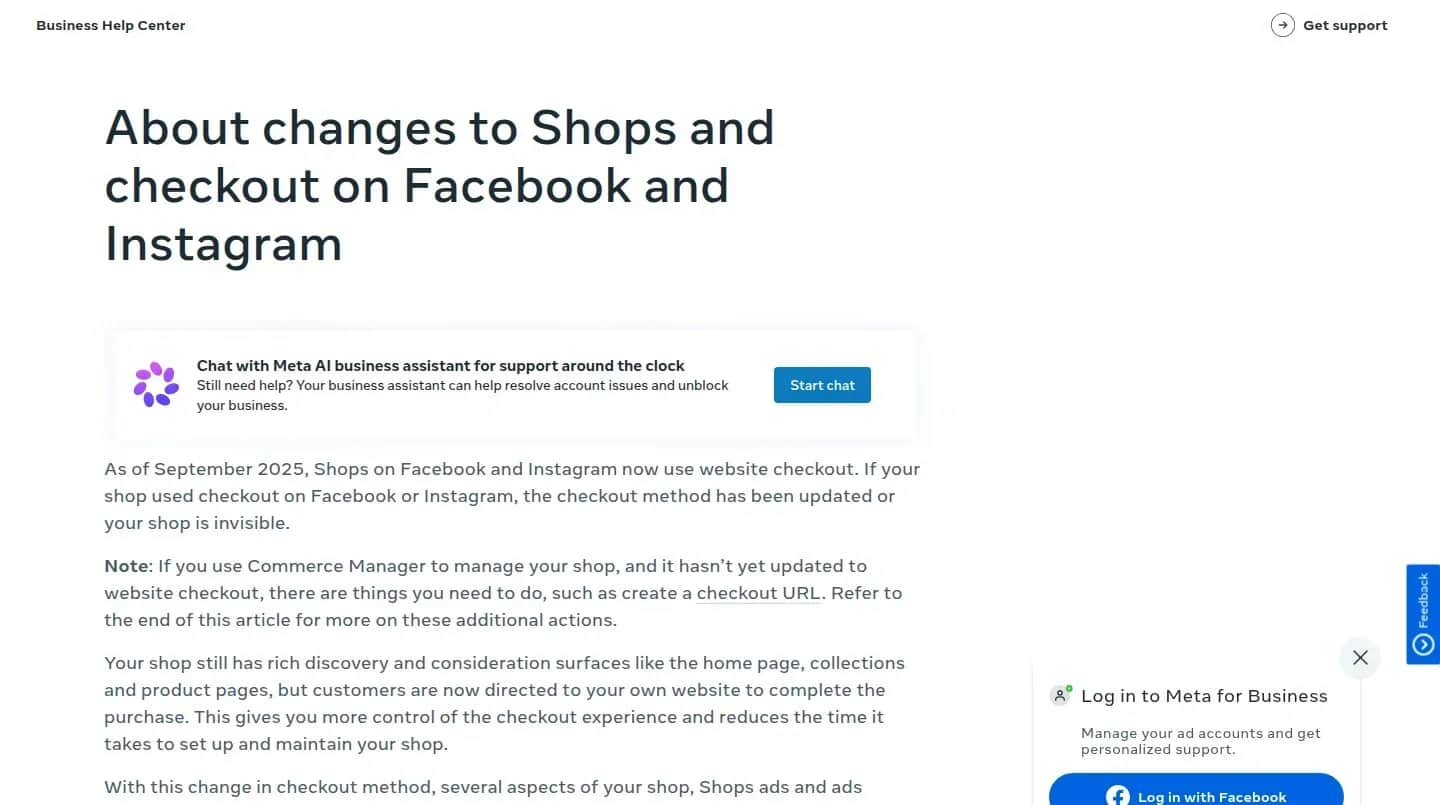
Meta: Facebook and Instagram Shops now use website checkout
facebook.com/business/help/1314349509894768, screenshot read 30 September 2026
The practical takeaway: Facebook and Instagram are a sales channel, not a free store. You can display products there, talk to customers and drive traffic, but the order and payment have to happen somewhere else — your own online store.
A marketplace instead of a store: you pay commission, not a subscription
A second "no subscription" route is a marketplace. The cost mechanism runs the opposite way from a SaaS store:
- no flat subscription for the storefront — the cost only shows up once you sell something;
- a commission on every sale per the marketplace's own fee schedule, worth adding up alongside payment and delivery costs for a single order;
- traffic comes from the platform — you don't have to build it from zero, but you compete on price and terms in the same search results as everyone else;
- the customer belongs to the platform — it owns the communication, reviews and selling rules, and you have limited say in how you appear next to competitors.
Amazon's EU seller page shows a Professional plan at €39/month excluding VAT, with "most referral fees between 8% and 15%" (Amazon cut FBA fulfilment fees from 15 December 2025 and referral fees in several categories from 5 January 2026). On eBay.de, a business seller's commission runs by category — Computers, Tablets & Networking at 7%, for example — plus €0.35 per order (€0.45 for orders over €10), excluding VAT; this is the German site specifically, and other EU eBay sites publish their own tables.
How widely do EU businesses actually sell this way? Per Eurostat (2025 survey, which covers sales in 2024; EU enterprises with 10+ employees and web sales), 45.0% sold via e-commerce marketplaces, while 85.65% sold through their own website or app, and 43.13% sold to other EU countries. A marketplace is clearly a mainstream channel, not a niche one. And because the two shares add up to well over 100%, at least two-thirds of the businesses selling on marketplaces must also be selling through their own site — the marketplace runs alongside the store, not instead of it.
At low volume, a commission usually comes out cheaper than a subscription. As sales grow, the total commission eventually overtakes the cost of running your own store — and that crossover point is worth calculating, not guessing.
Store creator — when it's enough, and when it stops paying off
A store creator is a platform where you build a shop from ready-made blocks, no coding required — Shopify, Wix and Squarespace all work this way. A free plan or trial has one good purpose: test an idea cheaply. A handful of products, a simple template, one payment method and one delivery method are enough to find out whether anyone will actually buy.
When a free or cheapest plan is enough
- you're testing whether a product sells and have a handful of listings;
- you sell occasionally, and turnover stays well under any VAT-registration threshold;
- you don't need integration with inventory, accounting, or a marketplace;
- you accept the look-and-feature limits of the plan you've chosen.
A reference point for small-scale selling
A useful, if imperfect, EU-level reference point is the SME VAT exemption scheme. Under Directive (EU) 2020/285, a member state can set a national VAT exemption threshold of up to €85,000; using that exemption across borders is capped at €100,000 of EU-wide annual turnover, and the scheme has applied since 1 January 2025. This is a VAT threshold, not a general permission to trade without registering a business — the exact national rule, and whether you need to register at all below it, depends on the member state.
If your sales are approaching that threshold, you're running a business, not a test — and it's worth calculating whether commissions, external-gateway surcharges and the limits of a free plan now cost more than an ordinary subscription.
Obligations are the same as in a paid store
A free store doesn't mean fewer obligations. Consumer-protection duties — terms, pre-contract information, pricing rules, the right to withdraw — apply regardless of what you pay for the platform. We cover the full list, with legal references, in how to start an online store.
When a store creator stops paying off
Signs that a free or cheapest plan is starting to cost more than it saves:
- surcharges on sales (platform commission or external-gateway fee) add up to more than the gap between plans;
- you're hitting a product or order limit, and every next step means a plan change;
- you need an integration the plan doesn't include — with a marketplace, an accounting system, a warehouse;
- handling orders takes you longer than the automation on a higher plan would cost.
If you want to compare specific platforms against these criteria, see our e-commerce platform comparison or try the which e-commerce platform quiz.
When to move to a paid plan, and how to take your data with you
Moving from a free plan to a paid one on the same platform is usually simple — pick a plan and pay. Switching platforms entirely is harder, because what matters then is what you can export. That's worth asking before you add your first product, not on moving day.
What vendor help pages confirm you can export (state as of 30 September 2026):
- Shopify — customers, orders and products to CSV (customers, orders, products);
- Ecwid — products, orders and customers to CSV (exporting orders);
- BigCommerce — an unpaid trial's data is kept for 90 days, then deleted;
- PrestaShop Hosted — the vendor states you can recover all your store's data when you cancel.
CSV moves data, but not everything: URLs, redirects, reviews, the template and integrations still have to be rebuilt. How to change platforms without losing your search rankings is covered in store migration, and the step list is in the migration checklist. Who's responsible for your data in a cloud service, and what to ask the vendor, is covered in cloud security.
When should you move to a paid plan? In short: when the free plan stops allowing sales (trial ended, no payments), when sales surcharges exceed the gap to a paid subscription, or when you need your own domain and integrations. What that will cost in your specific case is something you can check in the online store cost calculator — it compares platforms, integrations and payments in a few minutes. All our articles on choosing a platform sit in the platforms section.
FAQ
Frequently asked questions about free online stores
You can start without a subscription, but not without any cost. Open-source software (WooCommerce, PrestaShop), a SaaS trial or free plan, and a design template can all be free. You'll always pay the payment processor's own commission on every transaction — per 30 September 2026 price lists, for example 1.5% + €0.25 with Stripe — and usually a domain and your own time on top. "Free" is almost always a different billing model, not the absence of cost.
Not as a store. According to Meta, as of September 2025 purchases in Facebook and Instagram Shops end on the merchant's own website, and in-app payment processing has been discontinued entirely. Facebook and Instagram are a channel you can use to drive traffic, but the order and the payment have to happen in your own online store.
Square Online has a genuine ongoing free plan in Ireland and France (€0/month, 1.4% + 25 cents + VAT per EU/EEA card), confirmed on its own pricing pages as of 30 September 2026. Wix has a free plan too, but it can't accept payments — that needs a paid plan. Shopify and Squarespace offer time-limited trials instead of a permanent free tier; Ecwid no longer has a free plan at all.
The software is: WooCommerce is a free, open-source WordPress plugin, with no platform fees and no revenue share. You still pay for hosting (the vendor's own estimate is $25-350/month for most stores), a domain, extensions ($29-299/year each) and ongoing updates and security — done yourself or through a contractor.
It depends on the member state — EU law doesn't set one harmonised small-business threshold. A useful reference point is the EU SME VAT exemption scheme: member states can set a national VAT exemption threshold of up to €85,000, with cross-border use of that exemption capped at €100,000 EU-wide turnover (Directive (EU) 2020/285, applying since 1 January 2025). That's a VAT threshold, not a general trading permission — check your own country's registration rules. Consumer-protection duties, such as the 14-day right of withdrawal, apply regardless of how much you pay for the platform.
Outgrowing your free plan?
We'll help you work out whether staying on your current platform, moving to a higher plan, or building your own store makes more sense — and how to move your data without losing orders or search rankings.
Related Posts
- E-commerce platform — models, how to choose one and a guide to online store platforms
E-commerce platform: SaaS, open source or headless, five selection criteria, payment-method fees, data export and a guide to the section's articles.
- 1.Ecommerce Website Cost: Subscriptions, Fees, Setup and Monthly Costs of an Online Store
Ecommerce website cost in practice: Shopify, PrestaShop and Ecwid subscriptions, payment fees, and how to work out your own monthly TCO.
- 2.B2B ecommerce platform — what it is, how it differs from B2C and how to roll it out
A B2B ecommerce platform means per-customer pricing, credit limits, ERP integration, SaaS vs open source, EU e-invoicing (ViDA, Peppol) and a rollout plan.
- 3.Website migration SEO for online stores — a step-by-step plan, 301 redirects and data export
Website migration SEO for online stores: a 301 redirect map, data export, INP after launch and 90 days of monitoring, per Google's guidance.
- 4.Headless commerce — when a headless store makes sense, and when a classic one is enough
Headless commerce without the hype: how it differs from a classic store, Shopify Hydrogen, Medusa JS and Shopware pricing, costs, SEO, and when to skip it.
- 5.E-commerce Platform Comparison — Shopify, WooCommerce, PrestaShop, Shopware and More, by Price List and Exit Terms
Ecommerce platform comparison: Shopify, WooCommerce, PrestaShop, Shopware and more — model, EUR price, sales fees and data export, as of September 2026.
- 6.How to Start an Online Store and Create an Ecommerce Website — Product, Registration, Platform and Legal Duties
How to create an ecommerce website and start an online store: demand test, EU VAT thresholds, platform choice, legal duties and payments.
- 1.
About the Team
Digital Vantage Team
Your Partner in Business, Digital Vantage Team
Digital Vantage team is a group of experienced professionals combining expertise in web development, software engineering, DevOps, UX/UI design and digital marketing. Together we carry out projects from concept to implementation - websites, e-commerce stores, dedicated applications and digital strategies. Our team combines years of experience from technology corporations with the flexibility and immediacy of working in a smaller, close-knit structure. We work in agile methodologies, focus on transparent communication and treat each project as if it were our own business. The strength of the team is the diversity of perspectives - from systems architecture and infrastructure, frontend and design, to SEO and content marketing strategy. As a result, the client receives a cohesive solution where technology, aesthetics and business goals go hand in hand.