E-commerce operationsE-commerceOnline ShopsIntegrations12 min czas czytania13 218 znaków2227 słów
Omnichannel in e-commerce — what it is, and when to connect your store with a physical shop
Omnichannel in e-commerce: the definition versus multichannel, the shared-inventory mechanism between a store and a till, and when to implement it.
Redakcja Digital VantageYour Partner in Business, Digital Vantage Team · Digital Vantage team is a group of experienced professionals combining expertise in web development, software engineering, DevOps, UX/UI design and digital marketing. Together we carry out projects from concept to implementation - websites, e-commerce stores, dedicated applications and digital strategies.
Our team combines years of experience from technology corporations with the flexibility and immediacy of working in a smaller, close-knit structure. We work in agile methodologies, focus on transparent communication and treat each project as if it were our own business.
The strength of the team is the diversity of perspectives - from systems architecture and infrastructure, frontend and design, to SEO and content marketing strategy. As a result, the client receives a cohesive solution where technology, aesthetics and business goals go hand in hand.
Publikacja
Aktualizacja
Omnichannel in e-commerce comes down, for most small and mid-sized retailers, to one specific mechanic: the same stock level visible in both the online store and the till at a physical location, with the option to collect or return an online order in person. This article defines omnichannel, shows the mechanism behind a shared stock level between a store and a till, and sets out what to check before you invest in connecting the two.
Retailers who run at least one physical location alongside their online store, or who also sell on a marketplace, keep running into the same question: does the stock level a customer sees in one channel actually match what's physically available in the other? The answer decides whether omnichannel is a real improvement for your business, or just a buzzword with no technical substance behind it.
What is omnichannel, and how is it different from multichannel?
Shopify, an e-commerce platform with built-in integration between in-store and online selling, defines omnichannel marketing as "an integrated approach that uses many channels, such as social media, email, and SMS, to reach a customer," with the goal of creating "a consistent brand experience, no matter where a customer interacts with the company." As examples of omnichannel behaviour, the page lists buying in a physical store with home delivery, and click & collect — "the ability to purchase items online and pick them up in-store."
The difference between omnichannel and multichannel, which follows from that same definition, is about integration, not the number of channels — a conclusion drawn from Shopify's own wording, not a separately cited contrast. Multichannel means selling across several channels that can run independently of each other: a separate stock level for the online store, a separate one for the physical location, a separate customer history in each. Omnichannel is the same channels, connected by one shared stock level and one customer history — so a sale in one channel immediately changes what's visible in the other. That distinction matters in practice: simply running both an online store and a physical shop doesn't make you an omnichannel business if the two don't exchange stock and customer data with each other.
The tell that gives away multichannel pretending to be omnichannel is easy to spot from a customer's side: a product shown as available online turns out to be sold out in the physical shop (or the other way round), because two systems count stock independently and don't inform each other about sales. From the owner's side, the same mechanism shows up as two separate sales reports that can't be reconciled without manual recalculation — because each channel is only counting its own slice of reality.
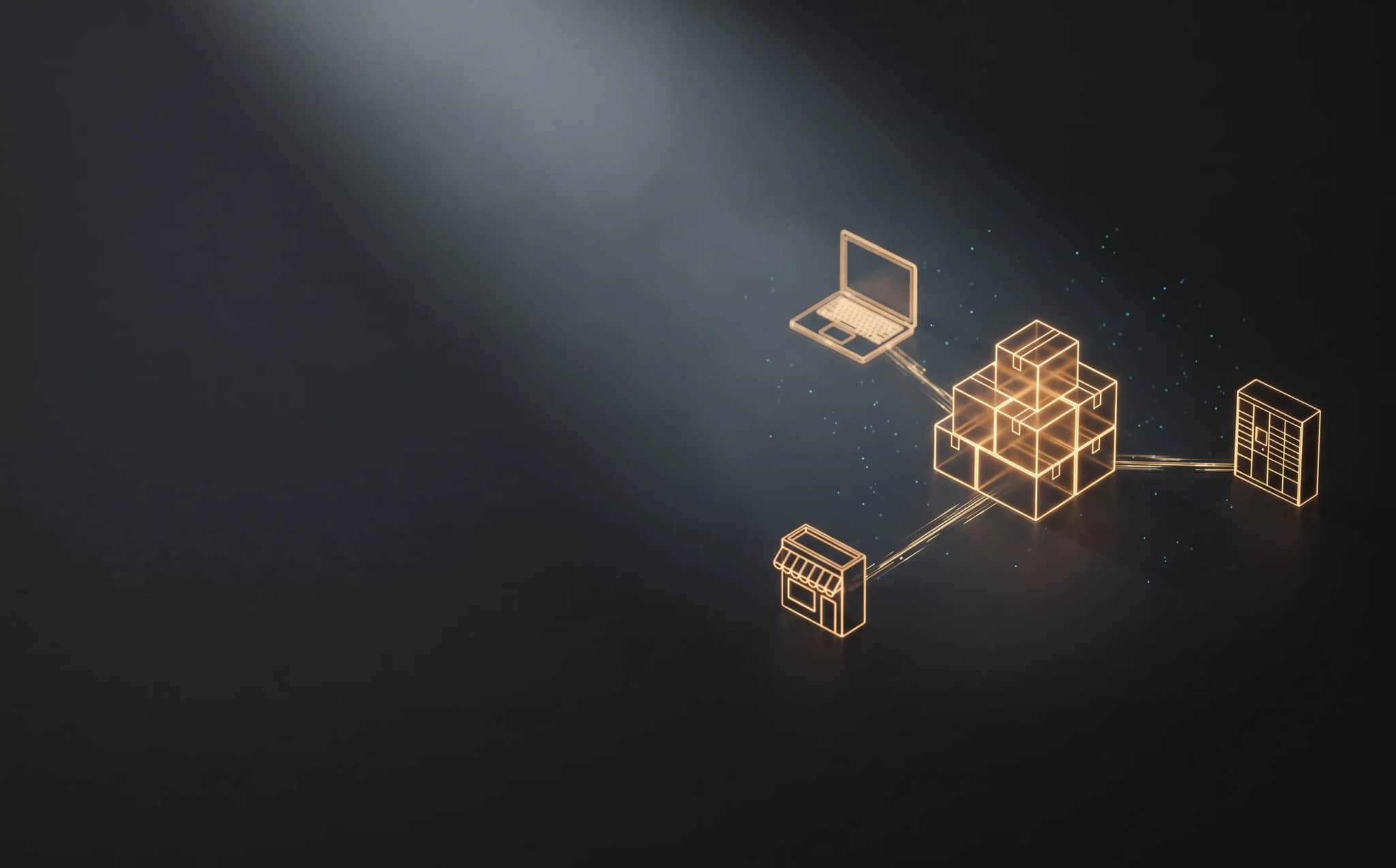
Omnichannel: one shared inventory, several sales channels
Digital Vantage diagram based on shopify.com/retail/omnichannel-retail and shopify.com/pos, read 1 October 2026
Shared inventory between the store and the till
The mechanism the whole idea of omnichannel rests on is stock synchronisation between channels in real time, or at least often enough that a customer doesn't buy something online that's physically no longer available in the shop. Shopify POS describes this as "a connected back office to sell in person, online, on social media, and marketplaces", one that lets you "sync inventory everywhere you sell" — a sale at the till and a sale online draw on the same stock figure.
If your store runs on a platform without built-in stock sync between channels, the same capability has to be built through integration — exactly the same data-architecture problem we cover in the context of ERP/WMS/CRM integration: there has to be one single source of truth for stock, and every sales channel (store, till, marketplace) has to read from it and write to it, rather than keep its own, local copy.
How often that sync happens matters in practice, not just technically. A setup where the till and the store exchange stock after every transaction minimises the risk of overselling, because the gap between systems lasts seconds, not hours. Integration built on a periodic export (say, once a day or every few hours) is simpler to set up, but leaves a window in which the stock level shown online may no longer match what's actually in the physical shop — and the risk grows with how fast a given product turns over.
Omnichannel also changes what you need from the team at a physical location, not just from the system. Staff at the till need to be able to see an order placed online, verify it (by order number or customer details, for instance), and handle the handover or a return without switching between two unrelated systems. If that process needs a phone call to head office or a check in a separate spreadsheet, part of the benefit of integrating the stock level gets eaten up by slower service on the floor — and it's the speed of that service, not just whether the channel exists, that decides whether a customer comes back to it.
Click & collect and in-store returns
In-store collection and in-store returns are the two customer-facing uses of a shared stock level; a return is simply the same mechanism run in reverse. You won't find a breakdown of delivery methods here, and that's deliberate: we found no comparable EU-wide figure. The Eurostat e-commerce tables we checked report whether people shop online and what they buy, not which delivery or return method they choose — so instead of an invented market share, here is the mechanism.
In practice, click & collect is worth implementing as an additional option rather than a channel you move your main logistics volume onto. Your main delivery method — courier, parcel locker or pickup point — stays the default, and click & collect serves customers who have a specific reason — same-day pickup, trying something on in person — to choose it instead.
Handling a return at a physical location runs on the same mechanism as click & collect: staff need to see the online order and be able to log the return so the stock level stays accurate, rather than have the item sit outside the system until someone notices it. Both collection and in-store returns also need a trained team and physical space for these orders — a separate shelf or area, marked by order number, so staff aren't hunting for a parcel among the stock currently for sale. That's a small, often underestimated cost of implementation: the system integration on its own isn't enough if the process on the shop floor isn't thought through the same way.
Marketplace as another channel
A marketplace is, from an omnichannel point of view, another sales channel that has to read from the same shared stock level as the store and the till — otherwise you risk selling the same item twice, in two channels at once. We cover marketplace integration separately, including how stock and price sync works; for omnichannel, what matters is only that a marketplace isn't an exception to the single-source-of-truth rule — it's just another channel that has to respect it.
A marketplace does differ from a physical location in one important way: you don't have operational control over it. You can't train a marketplace's staff or change its customer-service process — the only thing you manage is how accurately and how often your stock level reaches that platform. The more sales channels you run at once (store, till, at least one marketplace), the more it pays to have one central place — an ERP or a dedicated integrator — pushing stock out to all of them, instead of connecting every channel to every other channel individually.
Customer data across channels
Omnichannel also means customer data — purchase history, marketing consent, contact details — flows between channels instead of staying locked in one of them. That, in turn, means the same GDPR obligations that apply to your online store extend to data collected at a physical location and at the till: if a customer returns an order placed online at a physical shop, that order's data has to be available to the staff member handling it, under the same processing rules as in the online store. We cover the full scope of GDPR obligations — and PCI DSS for card payments in the online store — in a separate article on PCI DSS and GDPR.
The practical consequence for a small team: if marketing consent is collected separately online (a checkbox on a form) and separately in a physical shop (at the till, say), you need a single register that links both sources of consent for the same customer. Otherwise you risk sending marketing to someone who only consented in one of the channels, or blocking communication to someone who did consent — just in a different channel than the one you happen to check.
When omnichannel makes sense
The decision works the same way it does for fulfilment: omnichannel makes sense once you already have more than one sales channel — a store and at least one physical location, or a store and a marketplace with meaningful volume — and once the gap between them is actually causing problems: overselling, a customer who can't collect an order in-store because the stock level doesn't match, or two conflicting pictures of how much stock you actually have. If you only run an online store, with no physical location, omnichannel in the sense covered here doesn't apply to you — you have one channel, so there's nothing to integrate. If you run a physical shop alongside your store but the two operate on very different volumes and ranges (say, the online store only carries part of what's available in person), the benefit of full stock integration is often smaller than the cost of building it — a simpler approach, such as manual, less frequent syncing of selected items, can hold up for longer in that case.
Another signal that it's worth starting is the number of support tickets tied to a mismatch between channels — a customer asking whether a product shown online is really available at a specific shop, or showing up in person for an item that's already been sold to someone else. If that's rare, full integration can wait; if it happens regularly, the cost of not integrating — lost sales, staff time spent explaining the situation, customer frustration — can outweigh the cost of fixing it.
How to roll out omnichannel
It's worth breaking an omnichannel rollout into steps you can check before moving to the next one — switching on every channel and location at once raises the risk that a sync error hits your entire catalogue instead of one, controlled part of it:
- Check whether your e-commerce platform has built-in stock sync with a physical till (like Shopify POS), or whether you'll need to build it through integration with a separate system.
- Set one single source of truth for stock that every channel — store, till, marketplace — reads from, instead of letting each one keep its own copy.
- Roll out one extra collection channel first (click & collect at a single location) and watch how many orders actually go through it before extending it to every location.
- Set up the in-store return process so staff can log a return against an online order without manual tracking outside the system.
- Check that your policies and customer consent are consistent across channels before you start moving order data between the store and the physical location.
FAQ
Frequently asked questions about omnichannel in e-commerce
An integrated approach to selling across several channels — an online store, a physical location, a marketplace — built on one shared stock level and one customer history. That means a customer can, for example, buy a product online and collect or return it at a physical shop, and a sale in one channel immediately updates the stock level shown in the others.
The difference is about integration, not the number of channels. Multichannel means selling across several channels that can run independently of each other — with a separate stock level and a separate customer history in each. Omnichannel is the same channels, connected by one shared stock level and one customer history, so a change in one channel is visible in the others.
It makes sense if the gap between your online store and your till is actually causing problems — selling stock that's no longer there, or a customer who can't collect an order in person. If you run only one sales channel, or both channels run on completely separate, independent ranges, the benefit of full integration can be smaller than the cost of building it.
No — in most cases it works best as an additional option alongside your main delivery method, not a replacement for it. It suits customers who have a specific reason to collect in person, such as same-day pickup or trying an item on, rather than becoming the default choice for most orders.
Connecting an online store with a physical location?
We'll check whether your systems share one source of truth for stock and customer data, and tell you what's missing for omnichannel selling to work without mismatches.
Related Posts
- Ecommerce operations: the four processes that decide your costs after launch
Ecommerce operations after launch: orders and product data, warehouse and shipping, customer contact, measurement. What to automate, what to outsource.
- 1.Fulfillment in e-commerce — what it is, what it costs and when it pays off
Ecommerce fulfillment: what the service covers, how EU providers price it, and when outsourcing your warehouse pays off instead of doing it in-house.
- 2.Ecommerce KPIs — how to calculate GMV, AOV, conversion, CAC and LTV
How to calculate ecommerce KPIs — GMV, AOV, CAC and LTV — what GA4 calls a key event rate today, and how to build a five-number dashboard to run your store.
- 3.XML Product Feed and Supplier Integration: CSV or API for Your Online Store
How to integrate a wholesaler XML product feed, CSV file or API with your online store, and when each format actually makes sense.
- 4.ERP for ecommerce — integrating ERP, WMS and CRM without data chaos
ERP for ecommerce: how ERP, WMS and CRM own different data, three integration architectures, and what EU e-invoicing rules change.
- 5.Ecommerce Customer Service: Fewer "Where Is My Order?" Tickets
Ecommerce customer service: WISMO tickets, the EU AI Act chatbot-disclosure duty from 2 August 2026, and the two support metrics that actually matter.
- 6.PCI DSS and GDPR for an online store — what to get right before you accept card payments
PCI DSS v4.0.1, which SAQ applies to your payment setup, GDPR duties (Art. 6, 13, 28, 32), the 72-hour breach clock, and whether NIS2 applies to a small shop.
- 7.Ecommerce automation — what to automate first and how to calculate ROI
Ecommerce automation: what to automate first, Zapier, Make and n8n pricing, and a formula for ROI in hours worked, not promises.
- 1.
About the Team
Digital Vantage Team
Your Partner in Business, Digital Vantage Team
Digital Vantage team is a group of experienced professionals combining expertise in web development, software engineering, DevOps, UX/UI design and digital marketing. Together we carry out projects from concept to implementation - websites, e-commerce stores, dedicated applications and digital strategies. Our team combines years of experience from technology corporations with the flexibility and immediacy of working in a smaller, close-knit structure. We work in agile methodologies, focus on transparent communication and treat each project as if it were our own business. The strength of the team is the diversity of perspectives - from systems architecture and infrastructure, frontend and design, to SEO and content marketing strategy. As a result, the client receives a cohesive solution where technology, aesthetics and business goals go hand in hand.