E-commerceOnline ShopsAPIBackend DevelopmentProcess automationBusiness tools8 min czas czytania8527 znaków1434 słowa
Selling on EU Marketplaces — Amazon, eBay and Marketplace API Integration
Amazon's EU referral fees, eBay.de's per-order charges, and how marketplace integration works, with Allegro as a worked API example.

Redakcja Digital VantageYour Partner in Business, Digital Vantage Team · Digital Vantage team is a group of experienced professionals combining expertise in web development, software engineering, DevOps, UX/UI design and digital marketing. Together we carry out projects from concept to implementation - websites, e-commerce stores, dedicated applications and digital strategies.
Our team combines years of experience from technology corporations with the flexibility and immediacy of working in a smaller, close-knit structure. We work in agile methodologies, focus on transparent communication and treat each project as if it were our own business.
The strength of the team is the diversity of perspectives - from systems architecture and infrastructure, frontend and design, to SEO and content marketing strategy. As a result, the client receives a cohesive solution where technology, aesthetics and business goals go hand in hand.
Publikacja
Aktualizacja
Selling on a marketplace and selling from your own store run on two different cost structures. A marketplace takes a referral commission on every sale — on some marketplaces calculated on the total the buyer pays, delivery included — and may add a monthly plan fee. Your own store has no commission at all, but you have to bring every visitor yourself, through ads, SEO or email, and you pay for payments and shipping on your own terms. Marketplace integration only pays off once both channels share one warehouse and one order list — otherwise you're running two businesses with one set of stock.
This article sets out what Amazon, eBay and Zalando actually charge or disclose for EU sellers, uses Allegro — a Polish marketplace that has expanded into Czechia, Slovakia and Hungary — as a worked example of how a marketplace's own REST API handles authorisation and rate limits, and gives a framework for deciding between a ready-made connector and your own code.
What EU marketplaces actually charge
Amazon, on the English version of its seller fee page for Amazon.fr, lists two seller plans: an Individual plan at €0.99 per unit sold, and a Professional plan at €39 (excl. VAT) per month. On top of either plan, "most referral fees are between 8% and 15%" of the sale price, varying by category. Two recent changes moved specific categories: from 15 December 2025, Clothing and Accessories referral fees fell to 5% for items up to €15 and 10% for items between €15 and €20; from 5 January 2026, the Home Products category fell from 15% to 8%. Separate low-price FBA rates apply to items priced at or under €20.
eBay, on its German site for business sellers, charges a percentage of the total transaction value plus a fixed per-order fee of €0.35 (rising to €0.45 for orders over €10), both excluding VAT. Example category rate: Computers & Tablets at 7%. This table is specific to eBay's German site — other EU eBay marketplaces (France, Italy, Spain) publish their own fee tables, so check the one for the country you actually sell on rather than assuming they match.
Zalando runs a partner programme for marketplace sellers, but its commission structure is not publicly disclosed on its partner site — if you're evaluating it, you'll need to request current terms directly rather than rely on a published rate.
Allegro, based in and best known in Poland, is worth knowing as a channel if you sell into Central Europe. Per the company's own Q2 2026 investor results, it reports 21 million active buyers (15.6 million in Poland, 5.3 million abroad), more than 90 million products from over 150,000 sellers, and more than 9 million users of its Smart! delivery programme. The company has also launched local sites in the Czech Republic, and in Slovakia and Hungary in 2024. These are the company's own figures about its own business, not an independent market study. Its commission depends on the product category, so check the current fee table for the country site you plan to sell on.
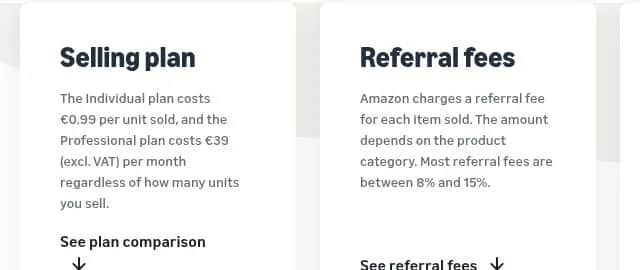
Amazon EU seller fees — official page
sell.amazon.fr/tarifs (English page), screenshot of 30 September 2026
What one order actually costs: marketplace versus your own store
To show how differently the two channels add up, we worked through one order at three price points. This is an illustrative calculation, not a recommendation of either channel — your own category's referral rate and your own payment provider will change the real numbers.
Assumptions: a single item, Amazon Professional plan, a representative mid-range referral rate of 10% (Amazon states most rates run 8–15%; we're using 10% as a clearly labelled midpoint, not a specific category rate), no advertising or FBA fulfilment fee included. Own store: payment via Stripe at the standard EEA card rate, 1.5% + €0.25. Shipping is left out of both channels: the parcel has to be sent whichever channel the order comes from, and its price depends on your carrier and country (see EU ecommerce shipping for that mechanism).
- €60 order. Amazon: 10% referral = €6.00. Own store: 1.5% × €60 + €0.25 = €1.15.
- €150 order. Amazon: 10% referral = €15.00. Own store: 1.5% × €150 + €0.25 = €2.50.
- €500 order. Amazon: 10% referral = €50.00. Own store: 1.5% × €500 + €0.25 = €7.75.
The pattern holds for any percentage-based commission: because the marketplace fee is a percentage, it scales with price; the payment-processing cost on your own store barely moves. What this calculation leaves out on purpose is a major cost difference between the two channels: customer acquisition. On a marketplace, the buyer is already there; in your own store, you have to bring them, through ads, SEO or email, and that cost depends entirely on your category and can't be estimated honestly without your own data. It also leaves out your platform subscription, covered separately in how much an ecommerce website costs, and payment-gateway specifics in payment gateway fees.
How marketplace API integration works, with Allegro as a worked example
Whichever marketplace you connect to, the integration typically goes through a REST API: the same interface a ready-made connector app and a custom-built integration both use to list products, update stock and prices, pull in orders, and create shipments. Three mechanics come up in any such integration, and Allegro's public developer documentation gives a concrete example of each:
- Authorisation. Allegro's API offers four OAuth flows: Authorization Code (the standard flow for an app acting on a seller's behalf, with PKCE recommended), Device flow (for apps with no browser), Client Credentials (public data only, such as the category tree), and Dynamic Client Registration for software that installs itself on a seller's own server. An access token is valid for 12 hours; a one-time refresh token extends authorisation for up to 3 months, after which the seller has to log in again.
- Rate limits and sandbox. Allegro's main limit is 9,000 requests per minute per Client ID; exceeding it blocks that Client ID for a minute and returns a 429 error. A sandbox environment, with the same limit, lets you test an integration before it touches real listings and real orders.
- Ongoing maintenance. Marketplace APIs change, and some changes break existing integrations. Between 18 August and 2 September 2026, Allegro's developer news page announced four API changes, two of them marked as breaking: a delivery-price-list field removed on 29 September 2026, and phone numbers without a country prefix rejected by its shipping service from 1 October 2026. Whoever owns the integration — the connector vendor, or you — has to track changes like these continuously, not just at launch.
These specific numbers belong to Allegro. Amazon and eBay document their own authorisation and rate-limit rules, so check those before you build against either. If you use a connector app from your platform's app store, this complexity is the vendor's problem, not yours; building your own integration means it becomes yours.
How a shop connects to a marketplace
Digital Vantage, based on developer.allegro.pl documentation, read 30 September 2026
Stock sync and the overselling risk
Overselling happens when the last unit of a product is bought in two channels at once, before the integration has time to reduce the stock count in the other one. The risk scales with one number: the interval between syncs. The longer it is, the longer a marketplace listing keeps showing stock you no longer have.
Even a connector advertised as syncing "in real time" isn't instantaneous — the connector documentation we checked describes updates landing within minutes rather than seconds, and warns that a large batch of changes can take hours to reach the marketplace. Three ways to cut the risk without necessarily paying for a faster plan:
- keep a buffer on the marketplace — list fewer units than you actually hold, especially for the last few;
- sell single-unit products through one channel only;
- confirm every listing is linked to an inventory record in your platform or connector, since syncing doesn't help a listing that was never tied to stock in the first place.
Remember what's on the other side of an oversold order: under a buyer-protection programme such as Allegro's, an order that is never shipped can mean the marketplace refunds the buyer and charges the amount to your account.
When to build your own integration
A ready-made connector is the right default for most stores: you pay a subscription, and the vendor absorbs API changes and rate limits. Building your own integration through the marketplace's API directly makes sense when:
- you run your own system — an ERP, a WMS, or a custom-built store — that no off-the-shelf connector supports, or supports only partially;
- you need logic no connector offers, such as custom pricing rules, stock reservation across warehouses, or splitting one order across multiple locations;
- a per-order fee grows faster than your margin — some connector plans charge per order, so work out at what order volume that cost overtakes the cost of maintaining your own code;
- you need a shorter sync interval than your current plan offers.
On the other side of that decision sit real, ongoing costs: registering an application and handling OAuth tokens, queuing requests under rate limits, testing in a sandbox, monitoring for errors, and — the part that never stops — adapting to API changes as the marketplace rolls them out. Allegro alone announced four API changes in about two weeks of August and September 2026. Treat a custom integration as an ongoing cost of doing business, not a one-off project; our ecommerce TCO calculator can help you weight it against everything else. If you're planning a store together with a marketplace channel from the start, estimate the launch cost in our online store cost calculator.
Five steps to deciding on marketplace integration
- Check the fee schedule for your exact category on each marketplace you're considering, not the headline range.
- Run one order through both channels using your own numbers — commission, payment fees, and shipping.
- Decide which marketplaces fit your assortment and countries — Amazon and eBay run separate country sites across the EU; Allegro covers Poland, Czechia, Slovakia and Hungary.
- Choose your integration method based on order volume and how fast you need stock to sync — a platform connector, a third-party integrator, or your own code.
- Set your stock-sync rules — a buffer on the marketplace, single-channel listing for last units, and every listing tied to an inventory record.
The remaining cost of a single order — payment, shipping and returns — is covered in payments and logistics.
FAQ
Frequently asked questions about marketplace integration
It depends on the category. Amazon states that most referral fees fall between 8% and 15% of the sale price, with specific categories priced differently — Clothing and Accessories fell to 5% for items up to EUR 15 and 10% for items between EUR 15 and EUR 20 from 15 December 2025, and Home Products to 8% from 5 January 2026. The Professional seller plan costs EUR 39 excluding VAT per month; the Individual plan has no monthly fee but costs EUR 0.99 per unit sold.
On eBay's German site for business sellers, yes: a percentage commission on the transaction plus EUR 0.35 per order (EUR 0.45 for orders over EUR 10), both excluding VAT. Example category rate: Computers & Tablets at 7%. Other EU eBay marketplaces publish their own fee tables, which may differ.
No. Zalando runs a partner programme for marketplace sellers, but its commission structure is not published on its partner site. You need to request current terms directly from Zalando.
As a documented example, Allegro's REST API limits requests to 9,000 per minute per Client ID, returning a 429 error above that; an access token is valid for 12 hours, refreshed by a one-time token valid for up to 3 months. Amazon and eBay document their own limits, so check them before you build.
Keep a stock buffer on the marketplace rather than listing every unit you hold, sell single-unit products through one channel only, and make sure every marketplace listing is linked to an inventory record. Even "real-time" sync can lag by several minutes, which is enough for two buyers to compete for the last unit.
Planning to sell on a marketplace alongside your store?
We'll help you cost out both channels on your own numbers and choose an integration method — before you commit to a connector or custom code.
Related Posts
- Payments and logistics in e-commerce — what fulfilling one order really costs
Payments and logistics in e-commerce: payment fees, shipping, packaging and returns per order under EU rules — and where no EU-wide price list exists.
- 1.One Stop Shop VAT and Selling Across the EU
The EU One Stop Shop: the EUR 10,000 EU-wide threshold, quarterly VAT returns, VAT rates by country, packaging registries, and the customer's own consumer law.
- 2.EU Right of Withdrawal: Returns and Guarantees in Online Stores
The EU right of withdrawal: the 14-day deadline, the model withdrawal form, refunds, the 2026 withdrawal button, and the two-year legal guarantee.
- 3.Ecommerce Shipping in the EU — Parcel Lockers, Volumetric Weight and Price Rules
There is no EU-wide shipping price list: Regulation 2018/644 sets transparency rules, and volumetric weight can double your shipping bill.
- 4.Payment Gateway Fees for Online Stores — Stripe, Mollie, Adyen and PayPal Compared
Payment gateway fees in the EU: Stripe, Mollie, Adyen and PayPal rates, interchange caps, the card-surcharge ban, SCA and Shopify's third-party gateway fee.
- 5.Online Payment Methods for EU Stores — Cards, Wallets, Bank Redirects and BNPL
Online payment methods for EU stores: card SCA rules, Apple Pay, Google Pay, iDEAL, Bancontact and Klarna BNPL rates, each with its published cost and risk.
- 1.
About the Team
Digital Vantage Team
Your Partner in Business, Digital Vantage Team
Digital Vantage team is a group of experienced professionals combining expertise in web development, software engineering, DevOps, UX/UI design and digital marketing. Together we carry out projects from concept to implementation - websites, e-commerce stores, dedicated applications and digital strategies. Our team combines years of experience from technology corporations with the flexibility and immediacy of working in a smaller, close-knit structure. We work in agile methodologies, focus on transparent communication and treat each project as if it were our own business. The strength of the team is the diversity of perspectives - from systems architecture and infrastructure, frontend and design, to SEO and content marketing strategy. As a result, the client receives a cohesive solution where technology, aesthetics and business goals go hand in hand.