E-commerceCMS - Content Management SystemWebsitesUX/UI designMarketing on the InternetIT strategy11 min czas czytania12 314 znaków2066 słów
Payments and logistics in e-commerce — what fulfilling one order really costs
Payments and logistics in e-commerce: payment fees, shipping, packaging and returns per order under EU rules — and where no EU-wide price list exists.
Redakcja Digital VantageYour Partner in Business, Digital Vantage Team · Digital Vantage team is a group of experienced professionals combining expertise in web development, software engineering, DevOps, UX/UI design and digital marketing. Together we carry out projects from concept to implementation - websites, e-commerce stores, dedicated applications and digital strategies.
Our team combines years of experience from technology corporations with the flexibility and immediacy of working in a smaller, close-knit structure. We work in agile methodologies, focus on transparent communication and treat each project as if it were our own business.
The strength of the team is the diversity of perspectives - from systems architecture and infrastructure, frontend and design, to SEO and content marketing strategy. As a result, the client receives a cohesive solution where technology, aesthetics and business goals go hand in hand.
Publikacja
Aktualizacja
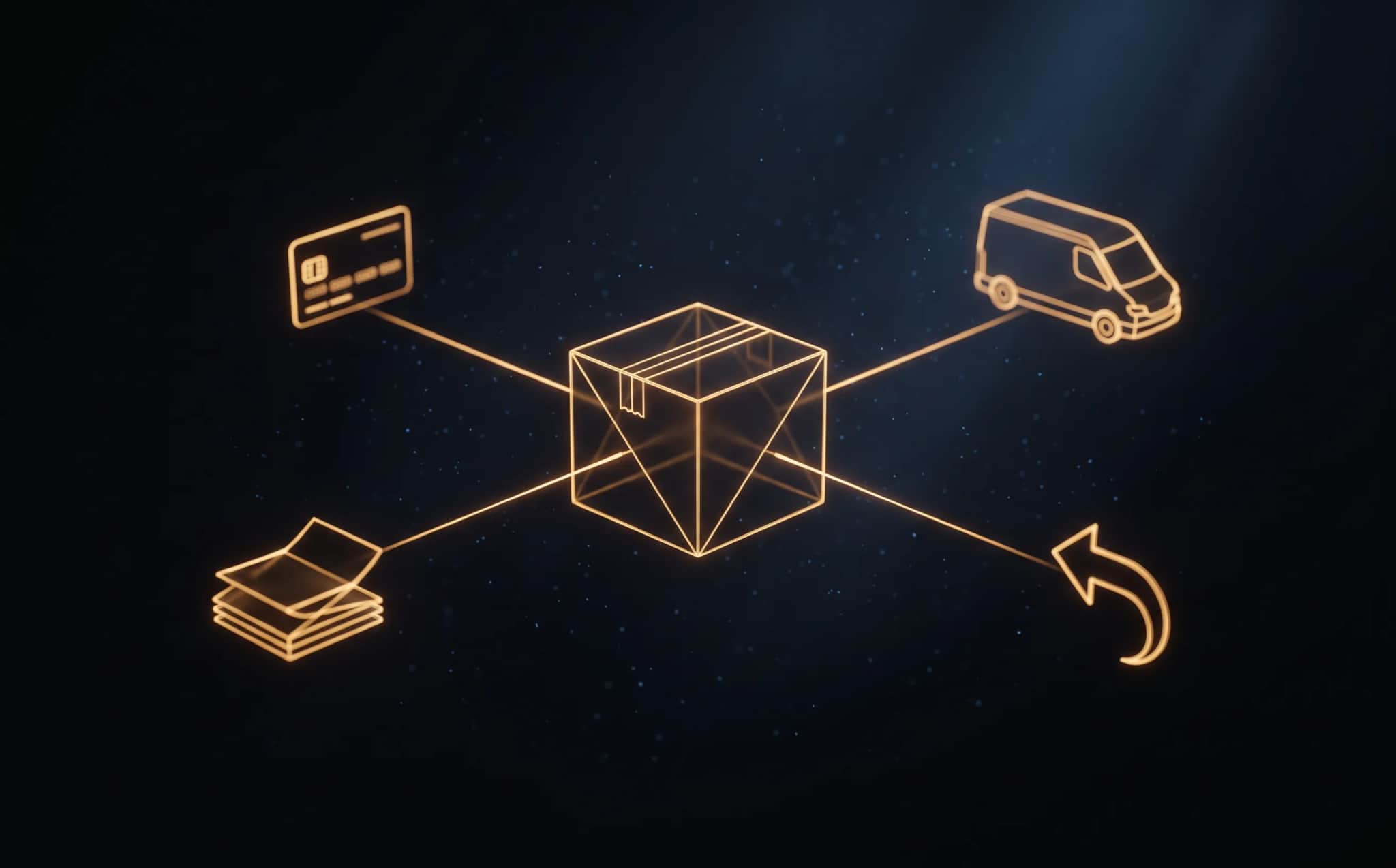
Payments and logistics in e-commerce are four costs you pay on every order, not once a month: the payment processor's fee, packaging, shipping and, on some orders, a return. On top of that there's the time someone spends picking and packing each parcel. A platform subscription shows up as a single line on a single invoice. These four costs are scattered across hundreds of small amounts, which is exactly why they're easy to overlook — and at a low basket value, they're what decides your margin.
This article maps the payments-and-logistics part of the section. It shows each of the four costs with a dated, sourced number where one exists, says plainly where one doesn't, works through one illustrative order, and points to six articles that go deeper on each topic. Prices come from price lists read on 30 September 2026 unless stated otherwise; price lists change several times a year and some figures are negotiable, so open the current version before you decide.
Payments in numbers: no single method, and two layers of fees
There's no EU-wide usage statistic for any single payment method of the kind some national operators publish — and forcing one would be misleading, because the method mix varies by the buyer's country — which is why PSPs list country-specific methods such as iDEAL | Wero, Bancontact, BLIK and Przelewy24 alongside cards, each at its own fee (Stripe, local payment methods; Mollie). What's common across the EU isn't a dominant method — it's the fee mechanics underneath whichever method the customer picks.
A payment service provider takes its own cut of every transaction. Stripe, for a standard European Economic Area card, charges 1.5% + €0.25 (Stripe, Ireland pricing, the same figure shown on the German page). On top of that, some SaaS platforms add their own charge if you don't route payments through their own processor: Shopify's Basic plan adds a 2% third-party-gateway fee whenever you accept payments through an outside provider (Shopify pricing; Shopify help) — a second cost on the same order, charged by the platform rather than the processor. Payout timing is set by each PSP's own contract, not by a single EU norm — some pay out daily, some weekly, some only once a cumulative balance is reached; check the contract, not the marketing page.
Two protections apply EU-wide regardless of which PSP you use. Under PSD2, a seller cannot charge the customer extra for using a card whose interchange fee is capped by EU regulation — in practice, standard consumer debit and credit cards (Art. 62(4), Directive (EU) 2015/2366). And under the regulatory technical standards on strong customer authentication, a remote card payment up to €30 can skip two-factor authentication, cumulatively up to €100 or five consecutive transactions (Art. 16, RTS (EU) 2018/389) — not €50, which is the separate exemption for contactless payments made in person, under Art. 11.
Rates for Stripe, Mollie, Adyen and PayPal, dispute fees and Shopify's gateway surcharge are compared in the payment gateway guide; the method mix European shoppers actually choose — cards, wallets, bank transfers, buy-now-pay-later — is in online payment methods.
Shipping in numbers: scale, but no single price list
InPost, best known in Poland for its parcel-locker network, is no longer a single-country operator. InPost Group's 2025 figures show 1,364.8 million parcels handled across its international footprint (+25% on 2024) and 62.0 thousand active automated parcel machines (+30% on 2024) (InPost Group).
What doesn't exist is a single EU-wide parcel price list. Regulation (EU) 2018/644 only requires carriers to file their public single-piece tariffs with their national postal regulator by 31 January each year, for the European Commission to publish by 31 March (Reg. 2018/644) — that's transparency for the walk-in, single-parcel rate, not for the negotiated business-contract rate a store actually pays. There's no EU aggregate figure to quote here; get a quote from your own carrier or broker and use that as your real number.
Carrier comparisons, locker networks and when fulfilment-by-third-party makes sense are in shipping in e-commerce.
Returns in numbers: no EU-wide rate, but a clear rule on who pays
None of the sources we checked has an EU-wide statistic on the share of online orders that come back. Eurostat's e-commerce tables measure something different — problems shoppers encountered while buying online, not what they sent back: 35.43% of EU online buyers hit at least one problem, most often slower delivery than promised, at 19.92% (Eurostat, isoc_ec_iprb21). That's a real, useful number — just not a return rate, so we're not borrowing it to stand in for one.
What is harmonised is who pays for a return. Under Directive 2011/83/EU, a trader refunds all payments the consumer made — including standard delivery — within 14 days of being notified of the withdrawal (Art. 13), and the consumer bears only the direct cost of sending the goods back, unless the trader agreed to cover it or didn't tell the customer about that cost upfront (Art. 14). The 14-day right, the model withdrawal form and the exceptions (personalised goods, perishables, unsealed hygiene items) are set out in full in returns and the legal guarantee.
If you offer a free return, you pay for the label — but there's no EU-wide price list for that either, for the same reason there's none for outbound shipping: it's negotiated with your own carrier.
Packaging: a cost nobody prices at EU scale
A box that's mostly empty air can cost more to ship than the product inside it warrants. InPost's parcel lockers, for one, price by size class, and some carriers' terms let them bill on volumetric weight — the box's dimensions divided by a carrier-specific factor such as 5,000 or 6,000 — whenever that exceeds the actual weight; Amazon's FBA rate card, for example, uses a divisor of 5,000. Oversize a shipment by a few centimetres and you can land in the next band up, so check your own carrier's terms.
Packaging also carries a registration duty, but not the same one everywhere. Each EU member state runs its own extended-producer-responsibility scheme and packaging register, with its own thresholds, exemptions and filing dates — check the rules of the member state you sell from; there's no single EU list, because none exists. What is EU-wide is Regulation (EU) 2025/40 (PPWR): e-commerce packaging may not exceed 50% empty space (Art. 24), a limit that applies from 1 January 2030 or three years after the Commission's implementing acts enter into force, whichever is later — inside a regulation that otherwise applies from 12 August 2026 (Art. 71) (PPWR, EUR-Lex).
We also didn't find a public, EU-wide price benchmark for shipping cartons or mailers — price your own from your supplier's invoice rather than from a figure we can't verify for your market.
What fulfilling one order actually costs — a worked example
To show how these costs stack, we priced one order. This is a worked example, not an offer or a market average.
Assumptions: an order for €150, paid with a standard EEA card via Stripe.
- Payment: 1.5% × €150 = €2.25, plus €0.25 = €2.50.
That's the only line we can price with a sourced, EU-wide number. Shipping and packaging don't get a line here, for the reasons set out above: neither has a public, EU-wide price list. Put your own carrier quote and your own supplier invoice in their place before you treat any total as real.
What's left, then, isn't a total — it's one verified cost (€2.50 on a €150 order, about 1.7%) and two gaps you fill in with your own numbers. At EU scale, with sellers spread across dozens of carriers and packaging suppliers, no public aggregate number exists for either line — and inventing one would be worse than leaving the gap open.
Time is a cost too: picking and packing
Every order has to be found, checked, packed, labelled and handed to a carrier by someone. We didn't find a public, reliable benchmark for how long that takes in a small shop, so we're not giving you a number. Measure it yourself: log your total packing time over a week, divide by parcels shipped, and multiply by the hourly cost of whoever does the packing — including your own time, if that's you.
A rough point of reference is the cost of outsourcing it: fulfilment providers charge a per-unit fee that bundles intake, picking and packing, on top of carrier charges. We didn't find a public EU-wide price list for that either, so treat it as a mechanism worth comparing against, not a number to quote — get an actual quote before you decide. Operational cost over several years is something you can total up in the e-commerce TCO calculator.
Payments and logistics in e-commerce — six articles
Which payment gateway should you use? Payment gateway fees compares Stripe, Mollie, Adyen and PayPal on commissions, fixed fees and dispute fees, covers Shopify's third-party-gateway fee, and prices one transaction at a €20, €100 and €300 basket.
Which payment methods should you offer? Online payment methods covers cards, wallets, bank transfers, buy-now-pay-later and cash on delivery, with the cost and risk of each.
Which carrier should you use? Shipping in e-commerce explains why there's no single EU parcel price list, how volumetric weight works, what the PPWR changes for box size, and when outsourced fulfilment is worth it.
How do you handle returns? Returns and the legal guarantee walks through Directive 2011/83/EU, includes the model withdrawal form, and breaks down the internal cost of a return.
How do you sell into other EU countries? Cross-border e-commerce explains the €10,000 OSS threshold, the OSS procedure, the buyer's home-country consumer law, and packaging registers abroad.
How do you connect your store to a marketplace? Marketplace integration covers the fee math and the integration itself: Amazon's EU Professional plan starts at €39/month excl. VAT (Amazon EU), eBay charges a percentage plus a fixed per-order fee, and Allegro remains one of the larger marketplaces in Central and Eastern Europe.
Tools
- [Online store cost calculator](pages:69b1d28de5961b9519f27fbc) — estimates your start-up budget by platform, integrations and payment setup.
- [E-commerce TCO calculator](pages:69bfe4fd0d5d51379c34263c) — totals subscription, add-ons, processing fees and upkeep over several years. Compare the rates in either tool against the price lists linked above before you rely on them — those are what's binding.
- [UX checklist for an online store](pages:69b904affd308268547d6371) — cart and checkout items, including payment and delivery choices, to check before launch.
- Our [report on online store costs in Poland](pages:6a881b92d619d2695247642d) — 108 publicly available price observations from 70 vendors on the Polish market, collected March–May 2026 — is useful background on methodology, not a benchmark for pricing an EU-wide store.
The platform you'll build all of this on is covered in the e-commerce platforms section; the rest of the e-commerce section starts at the e-commerce guide.
FAQ
Frequently asked questions about payments and logistics in e-commerce
It depends entirely on your own rates. In our worked example for a €150 order paid via Stripe, only one line has a sourced, EU-wide number — the payment fee, about €2.50 (1.7% of the order) — because shipping and packaging have no EU-wide price list. Price those from your own carrier quote and supplier invoice.
We can't answer that at EU scale with a sourced number, because carrier rates are negotiated and not public. Compare your own payment-processor fee against your own shipping quote; the balance shifts with your basket size and your negotiated carrier rate.
The trader refunds everything the customer paid, including standard delivery, within 14 days of being notified (Directive 2011/83/EU, Art. 13). The customer pays only the direct cost of sending the item back, unless the trader agreed to cover it or didn't disclose that cost upfront (Art. 14).
In principle, yes, in whichever EU country you sell from — but the scheme, thresholds and deadlines are set by each member state, not by a single EU register, so check the rules where you're established. One EU-wide rule that does apply everywhere is Regulation (EU) 2025/40 (PPWR), which caps empty space in e-commerce packaging at 50% (Art. 24), with that limit applying from 1 January 2030 or three years after the Commission's implementing acts enter into force, whichever is later.
Want to price order fulfilment for your own store?
We'll help you work out payment fees, shipping, packaging and returns on your own numbers, and choose a platform that doesn't add its own fees on top.
Related Posts
- Payments and logistics in e-commerce — what fulfilling one order really costs
Payments and logistics in e-commerce: payment fees, shipping, packaging and returns per order under EU rules — and where no EU-wide price list exists.
- 1.One Stop Shop VAT and Selling Across the EU
The EU One Stop Shop: the EUR 10,000 EU-wide threshold, quarterly VAT returns, VAT rates by country, packaging registries, and the customer's own consumer law.
- 2.EU Right of Withdrawal: Returns and Guarantees in Online Stores
The EU right of withdrawal: the 14-day deadline, the model withdrawal form, refunds, the 2026 withdrawal button, and the two-year legal guarantee.
- 3.Ecommerce Shipping in the EU — Parcel Lockers, Volumetric Weight and Price Rules
There is no EU-wide shipping price list: Regulation 2018/644 sets transparency rules, and volumetric weight can double your shipping bill.
- 4.Payment Gateway Fees for Online Stores — Stripe, Mollie, Adyen and PayPal Compared
Payment gateway fees in the EU: Stripe, Mollie, Adyen and PayPal rates, interchange caps, the card-surcharge ban, SCA and Shopify's third-party gateway fee.
- 5.Online Payment Methods for EU Stores — Cards, Wallets, Bank Redirects and BNPL
Online payment methods for EU stores: card SCA rules, Apple Pay, Google Pay, iDEAL, Bancontact and Klarna BNPL rates, each with its published cost and risk.
- 6.Selling on EU Marketplaces — Amazon, eBay and Marketplace API Integration
Amazon's EU referral fees, eBay.de's per-order charges, and how marketplace integration works, with Allegro as a worked API example.
- 1.
About the Team
Digital Vantage Team
Your Partner in Business, Digital Vantage Team
Digital Vantage team is a group of experienced professionals combining expertise in web development, software engineering, DevOps, UX/UI design and digital marketing. Together we carry out projects from concept to implementation - websites, e-commerce stores, dedicated applications and digital strategies. Our team combines years of experience from technology corporations with the flexibility and immediacy of working in a smaller, close-knit structure. We work in agile methodologies, focus on transparent communication and treat each project as if it were our own business. The strength of the team is the diversity of perspectives - from systems architecture and infrastructure, frontend and design, to SEO and content marketing strategy. As a result, the client receives a cohesive solution where technology, aesthetics and business goals go hand in hand.