IT strategyWebsitesMarketing on the Internet24 min czas czytania28 791 znaków4629 słów
Website marketing strategy — where the customers actually come from
Four channels, when each one works, and what is left when you stop paying. With the traffic split from our own site, and how to cost a single enquiry.

Redakcja Digital VantageYour Partner in Business, Digital Vantage Team · Digital Vantage team is a group of experienced professionals combining expertise in web development, software engineering, DevOps, UX/UI design and digital marketing. Together we carry out projects from concept to implementation - websites, e-commerce stores, dedicated applications and digital strategies.
Our team combines years of experience from technology corporations with the flexibility and immediacy of working in a smaller, close-knit structure. We work in agile methodologies, focus on transparent communication and treat each project as if it were our own business.
The strength of the team is the diversity of perspectives - from systems architecture and infrastructure, frontend and design, to SEO and content marketing strategy. As a result, the client receives a cohesive solution where technology, aesthetics and business goals go hand in hand.
Publikacja
Aktualizacja
A website marketing strategy comes down in practice to four channels: unpaid search results, paid search, social media, and referrals from other websites. Each works at a different speed, costs a different amount, and leaves something different behind on the day you stop paying for it.
Below is a map of those four, and immediately after it the thing most guides leave out: with the measurement a small firm typically has, close to half the traffic lands in a bucket nobody knows anything about. We show that on our own numbers, because they are the only ones we can verify.
What you will find here. A map of four channels compared on speed, cost and durability; what can be done before any budget exists; the traffic split from our own site over twelve months; what "direct" visits really are; how to work out the cost of a single enquiry; a measurement checklist; and an order of work for the first three months.
Four channels — the map every website marketing strategy starts from
Before any numbers, a comparison that fits on one screen. The "what is left" column is the one least often mentioned when a budget is decided, and it is the one that determines whether the money was a cost or an investment.
Channel | When it works | What is left when you stop paying | What it is good for |
|---|---|---|---|
Search — unpaid results | months | content and positions keep working | a steady flow of enquiries with buying intent |
Search — paid | from day one | nothing | an urgent need for enquiries, testing hypotheses |
Social media | weeks | reach and recognition | building a brand where nobody is searching |
Referrals from other sites | months | links work for years | credibility, and traffic you forget about |
Channel names tell you where a visit came from. They do not tell you what the channel is good for, and that distinction is what decides a budget.
Search, unpaid results (16.1% of our traffic). The only channel in which you meet a person at the moment they are looking for a solution themselves. It has two properties you cannot design around: it works with a delay measured in months, and it does not begin to work at all until the site is in the index. How long that takes and what it depends on is set out in how long SEO takes to work.
Search, paid (13.2%). The same moment and the same intent, bought rather than earned. The advantage is that it works from the first day. The drawback is that it stops working on the day the card is declined, and leaves nothing behind. This is the channel for testing a hypothesis, and for the periods when you need enquiries now rather than in six months' time.
Social media (10.7% unpaid, 4.9% paid). Here you reach people who were not looking for anything. That is why the traffic can be plentiful while the enquiries in it are few — not a flaw in the channel but its nature, and the reason it is judged unfairly more often than any other. The risk of resting an entire commercial presence on somebody else's platform we cover separately.
Referrals from other sites (5.7%). Directories, articles, mentions, trade portals, the supplier page of a client who lists who built their site. The least impressive channel on the list and the most underrated, because it keeps working long after everyone has forgotten it was set up.
Now notice something about those figures: all four channels together account for a little over half the traffic. The remainder sits in a bucket that cannot be attributed to anything. Any marketing plan that ignores this is built on half the data while presenting itself as complete.
Marketing on no budget — what to do before you spend
Before you spend the first euro, it is worth exhausting what is free — in a small firm that is almost always where the largest unused reserve is sitting.
The Google Business Profile — the cheapest channel you have
It deserves a separate mention, because it does not appear as its own line in the table above, and for a firm working locally it is sometimes more important than the website itself.
The profile and the site do not compete with each other; they do two different jobs on the same path. The profile decides whether anybody sees your name in local results at all. The site decides what happens next, once that name has appeared and the customer wants to check who they would be dealing with. A firm with a good profile and no site collects calls from people who had no way to verify anything before ringing; a firm with a site and no profile is simply absent at the moment the decision is taken.
For budgeting purposes that produces a simple order of operations: if you work locally and the profile is unfinished, finishing it is the cheapest action on the entire list — free, and doable in a single evening. What to fill in and how to keep it alive is in a separate guide to the Google Business Profile.
Referrals — you cannot buy them, but you can increase them
If the largest share of traffic is in practice word of mouth, the obvious question is what can be done about it other than waiting. Three things, all free, all neglected.
Ask at the moment the customer is pleased. Not a month later by email, but at the point where they are taking delivery of finished work and telling you themselves that it is good. It is the only moment at which the request is not awkward, and the only one at which most people actually do something about it.
Make referring technically easy. Somebody who wants to recommend you needs something to send. A short web address, a profile with a code, a ready-made link to leave a review. If passing your name on requires digging an email out of a six-month-old inbox, it will not happen — and not because the person did not want to.
Turn the referral into a review that stays. The conversation disappears the moment it ends; a public review stays and keeps working on later customers who will never meet the person who left it. It is the only mechanism we know of that makes a one-off recommendation work more than once. How to ask for reviews and how to reply to them we describe separately.
There is a catch that follows directly from the second half of this article, and it is worth stating now rather than as a footnote: you will not see the effect of any of those three in a report. Visits that began as a recommendation land in "direct" and mix in with everything else there. The only instrument left is the question you ask new customers — which is why the checklist further down gives that question the same weight as an analytics event.
Two things this map deliberately leaves out
The four-channel map is useful precisely because it is short, but two absences in it are deliberate rather than accidental, and both matter when a budget is being argued about.
Email and any other list you own. A list of addresses you collected yourself is not a channel in the same sense as the four above, because it does not bring you strangers. It brings back people who already know you, which makes it the cheapest way to get a second conversation and no way at all to get a first one. It belongs in the plan, but not in a comparison of acquisition channels — counted alongside them, it looks miraculously efficient for the same reason that ringing your existing customers does.
Everything that happens offline. Trade bodies, events, subcontracting relationships, the person who worked with you three jobs ago and now runs procurement somewhere else. None of it appears in a web report, all of it appears in revenue, and for B2B firms it is frequently the largest single source of work. The point is not that you should measure it — mostly you cannot — but that a budget decision made from a report is a decision about the part of your business a report can see.
Why a map of channels is not enough
Most guides to marketing a business online finish at the map. They list the channels, describe what each one does, and leave the reader with the decision about which one to spend on.
The problem is that the decision cannot be made without an answer to a question those guides do not ask: will you be able to see which channel worked? What follows is what that looks like in practice, on our own data, because other people's we have no way to check.
This is the traffic on our own company site over the last twelve months, split by channel, as Google Analytics reports it. We publish the proportions and not the volume, and that is a deliberate choice rather than modesty: the volume would tell you something about us, and the proportions tell you something about measurement. Only one of those two is useful to you, and it is the one that travels to a site of any size.
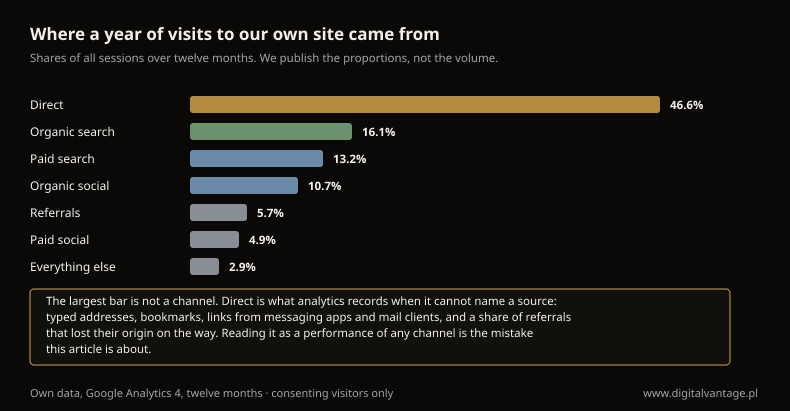
Where a year of visits to our own site came from
Own data, Google Analytics 4, twelve months
Channel | Share |
|---|---|
Direct visits | 46.6% |
Search — unpaid results | 16.1% |
Search — paid | 13.2% |
Social media — unpaid | 10.7% |
Referrals from other sites | 5.7% |
Social media — paid | 4.9% |
All remaining | 2.9% |
This is one services firm's website in one European market, not a market benchmark, and it should not be read as one. What makes it worth showing is that the shape of it is not a property of our market or our size. It is a property of how attribution works, and the same shape appears in every small-firm report we are shown.
The same data month by month
An annual share smooths out everything that is interesting about it. Read one month at a time, the same twelve months behave quite differently — and two things stand out, both of which teach more about measurement than about the market.
The largest line is the least stable. Direct visits roughly tripled between September and December and then fell back to a small fraction of that peak, where they stayed. The channel we know the least about is also the one that moves the total the most — which means that a budget planned on the basis of the headline figure would be planned on the weakest number available.
April 2026 is where comparability breaks. Paid campaigns started then, and enough changed at our end that the two stretches cannot honestly be read as one trend. We mark the break rather than smoothing it over, because recognising a break like that is exactly the skill worth having when somebody hands you a report: a jump or a collapse in the data more often means a change in the measurement than a change in the market. Before you draw any conclusion from your own chart, work out what was changing on your side of it on that date.
"Direct" is not a channel
This is the most common misunderstanding in conversations about marketing channels, and it is worth closing before anything else is decided.
A visit lands in this category when the browser passed no information about where it came from. It does not mean "the user typed the address from memory". In practice at least four different things end up there:
- A typed address or a bookmark — the only case that actually matches the name of the channel.
- A link clicked inside an email, a messaging app, or a PDF. A mail client is not a web page and has nothing to pass on.
- A link from a mobile app that does not forward a source.
- A move from an HTTPS page to a site still partly served over HTTP — the source information is deliberately stripped in that case.
It is worth reading how Google itself defines the category. The documentation on default channel groups describes it in plain language as traffic arriving "via a saved link or by entering your URL" — but the matching rule it then gives is a different thing entirely: source equal to (direct) and medium set to (not set) or (none). The first sentence describes a user's intention; the rule describes missing data. Everything that satisfies the rule lands in the channel, whatever the person actually did.
The second item on that list is the one that changes how the whole table reads. A recommendation from a colleague, sent by text message or over a messaging app, looks in the report exactly like somebody typing your address from memory. The largest bar on the chart is, in large part, not direct traffic at all. It is referral traffic that nobody has a way to count.
The practical conclusion is an uncomfortable one. The channel that brings most customers to most small firms is also the one that cannot be scaled by spending money on it — which is precisely why it is missing from the guides that end at the map.
Three things the split does not show at all
Every figure above is a lower bound, and for three independent reasons.
Cookie consent. The measurement sees only the visitors who accepted the banner. The rest are not estimated or modelled, they are absent. In Europe that is not an edge case but the default condition of every analytics property, so every percentage above is a share of a base smaller than reality — by an unknown but certainly non-zero amount.
Phone calls. This is the most expensive measurement mistake we know of, because we made it on our own site. For a period our report showed zero form submissions, and that was entirely true. What was untrue was the conclusion drawn from it, that there were no enquiries. People were simply ringing, and a phone call leaves no trace in any web analytics tool. If there is a telephone number on your site, some proportion of your enquiries is certainly not being counted.
Searches for your own name. Somebody hears about you from a customer, types your company name into a search engine and arrives. In the report that looks like a search ranking success. In reality it was a referral, and the search engine acted as a telephone directory. That single mechanism credits unpaid search with results it did not produce, and hides how well word of mouth is working, in the same stroke.
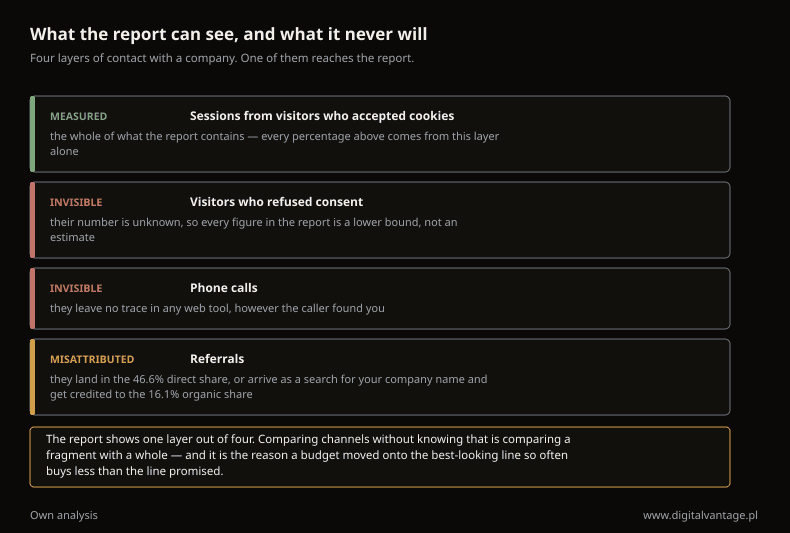
What the report can see, and what it never will
Own analysis
Three sentences after which it is worth asking for the source data
- "Direct traffic is your brand" — partly, but the same category holds referrals from messaging apps and links from emails.
- "The campaign brought X visits, so it works" — a visit is not an enquiry; the question is how many of them ended in a conversation.
- "The analytics shows the full picture" — it shows the visitors who accepted cookies, and it sees no phone calls whatsoever.
Cost per enquiry — the only number that compares channels
Visits from different channels are not comparable with one another, because they come from people who are interested to wildly different degrees. A hundred visits from a search result and a hundred from a social post are two different substances. What is comparable is the cost of one enquiry, worked out separately for each channel.
The arithmetic is simple and fits into a single table. Fill it in with your own figures for the last quarter — a quarter rather than a month, because at small numbers a month is noise.
What to count | Where it comes from |
|---|---|
Spend on the channel | Advertising invoices, or your own time × an hourly rate |
Number of enquiries from the channel | Form submissions, calls, messages — all of them together |
Cost per enquiry | Spend divided by the number of enquiries |
How many became customers | From your own notes, not from the reporting |
Cost per customer | Spend divided by the number of customers |
Two notes on that calculation, without which it reliably produces nonsense.
Your own time is a cost. A "free" channel run for four hours a week is not free; it is paid for in time that could have gone on billable work. Enter that time honestly at a real rate, or social media will win every comparison you ever run, for the sole reason that its invoice never arrives.
A channel with no attributed enquiries does not mean "ineffective". It means "unmeasured". Before you write one off, check whether it had any mechanism by which it could have shown up at all — which is what the checklist below is for.
In practice this calculation usually ends in one of two discoveries. Either the most expensive channel turns out to be the only one delivering customers rather than enquiries, or the cheapest one turns out to cost more than advertising once somebody's time is priced into it.
The order of channels depends on the trade
The same set of channels arranges itself in a different order depending on how the customer makes the decision, which is why there is no single website marketing strategy that fits every firm. Three arrangements we see most often:
Local services with an urgent need — plumbers, electricians, repair firms, builders. The customer has a problem right now and is looking for the nearest contractor who will answer the phone. Here the Google Business Profile and visibility in local results win outright, and the website's job is to confirm that the firm is real. Paid search works but can be expensive, because everybody within twenty kilometres is bidding on the same handful of phrases.
B2B services with a long decision — projects, consultancy, contracting for other companies. Weeks pass between the first contact and a signature, and more than one person is involved in deciding. Here content and unpaid search results do the work, because somebody reads, compares, leaves, and comes back. Referrals weigh more heavily than any other channel and are simultaneously the worst represented of all of them in a report.
Products and mail order. The decision can be immediate, so advertising produces an effect from the first day, and social channels genuinely sell, because the product can be shown rather than described. This is the only one of the three arrangements in which traffic with no prior intent turns reliably into revenue.
If your firm belongs to the first arrangement and the budget is going into content and national-level search rankings, that is the most common mistake on this list and also the easiest one to correct.
Check your own measurement before you spend anything
Buying traffic while the measurement is broken ends the same way every time: the money moves to the channel that looks best in the report rather than the one that brings customers, and there is no way to tell from inside the report that this is what happened.
Lista kontrolna · 12 pkt
Is your measurement fit for taking decisions
Eight things to check in the reporting and on the site itself. Tick what you have.
0/ 8zaznaczone
0%This data cannot support a budget decision
Before you buy anything, fix the measurement — otherwise the first conclusions from a campaign will be accidental. That is a few hours of work, not a project.
Why visits are rising and the phone stays silent
This is the most common question we are asked after the first few months of any activity at all, and it almost always has one of three causes. They are worth telling apart, because they lead to three entirely different decisions.
The traffic does not match the offer. People arrive because the site answers a question your customer never asks. The classic case: a contractor publishes a guide on how to lay tiles yourself and acquires an audience of people who have just decided not to hire a contractor. Search Console settles this in minutes — if the phrases you appear for begin with "how to do it yourself", you have your answer and you have it for free.
The traffic matches, but the site makes contact difficult. A number buried in the footer, a form with eight required fields, nothing about price and nothing about which areas you cover. The traffic is right and it is being lost on the last metre. This is the cheapest of the three problems to fix and the one most often missed, because no report reveals it — only a stranger trying to get in touch does.
The enquiries are there and you cannot see them. People are ringing. They are messaging. They are replying to something you sent a month ago. Before concluding that a channel does not work, count every route by which people actually reach you, including the ones no tool will ever register.
The order of investigation is always the same: the third cause first, because checking it is free; then the second, because fixing it is cheap; the first one last, because fixing that means changing content or campaigns and therefore money.
The first three months, starting from zero
If what you want is an order of operations rather than a list of possibilities, this one works for services firms and requires no budget to begin.
Month one — visibility and measurement. A finished Google Business Profile, contact details fixed on the site, an event on the form, a tappable phone number, and one question asked of every new customer. None of it costs money; all of it costs a few hours.
Month two — content that answers real questions. Not a blog. Service pages describing what customers already ask about on the phone: scope, coverage, lead times, an indicative price. That material answers search queries and shortens sales conversations at the same time, which is why it is the best-value writing you will do.
Month three — only now paid traffic, if at all. With measurement that works and pages worth pointing at, you can buy traffic and find out within a fortnight what a conversation costs you. Without the first two months, the same campaign produces numbers from which nothing whatsoever follows.
This order is dull, which is why it is rarely the one proposed to you. Its advantage is that every step can be abandoned without loss — whereas a campaign switched on at the start usually costs about as much as learning the same lesson from your own data would have done.
What this means for a budget
Four conclusions, all of them straight out of the figures above.
Do not move budget towards the channel that "has the most visits". The largest line in the table is a bucket for unrecognised sources, not a channel anybody can buy more of. You can only compare channels you measure in the same way — and even then the sensible unit is conversations, not visits.
Before adding traffic, check what happens to it after it arrives. Doubling the number of visits at an unchanged enquiry rate also doubles the cost of a single enquiry, if that traffic was paid for. That side of the arithmetic is covered in the article on conversion optimisation, and measurable goals in website KPIs.
Do not judge a channel over anything shorter than a quarter. At a few dozen enquiries a year, a month is noise rather than measurement — two good weeks and two poor ones can reverse the verdict in either direction. Switching a channel off after thirty days is a coin toss, only more expensive, because it has already cost a month of spending and it usually ends with the budget moving to a channel judged just as hastily.
Count referrals by hand. One question in the first conversation — "how did you come across us?" — recorded consistently for three months buys knowledge that no tool sells. At most services firms that start asking it, the answer looks nothing like the report.
If you want to go deeper. How long SEO takes to work explains why the unpaid channel does not start producing immediately. Why a website is worth having answers the question of return on the site itself. Website audit describes what we check before advising anybody to add traffic to what they already have.
We will find out where your customers really come from
Before advising on any budget, we look at what you already have: the measurement, the site, and the channels that are working without being paid for.
Related Posts
- Nine website situations — and which text answers each one
Nine situations firms arrive with: planning, audit, modernisation, measuring results. Pick the one that describes yours and go straight to the specifics.
- 1.Website audit — what we actually check, what it costs and what you get out
Three layers in the order that matters, the list of checks, and the price stated outright. With three findings an owner will never spot on their own.
- 2.How long does SEO take — and why the first weeks do not count at all
Indexing and ranking run on two different clocks. The four gates a site passes through, with the times measured on our own corpus rather than quoted.
- 3.Small business website — what changes from one trade to the next
In construction the photographs decide it, in hospitality the menu and the opening hours, in haulage the proof you exist. Five trades, five priorities.
- 4.Outdated website — when the calendar decides, not taste
PHP 8.2 loses support on 31 December 2026, Chrome is forcing HTTPS, certificates are down to 200 days. Six deadlines you had no part in setting.
- 5.Website redesign or optimisation — how to settle it before you spend
Four questions that settle whether a site needs rebuilding or only fixing. With the decision diagram and the risk the quotes stay quiet about: your URLs.
- 6.Website strategy — five decisions taken before the first design is drawn
Why the site exists, who it speaks to, how it is ordered and what it runs on. Five decisions, each with the criterion that actually settles it.
- 7.Website KPIs — four ways your numbers are lying to you
Consent banners understate traffic, key events are not leads, your own visits stay in the data for good. Four traps, and which way each one skews.
- 8.WCAG compliance — who it actually binds and what has to be done
The European Accessibility Act has applied since 28 June 2025, but only to a listed set of services. Check whether it reaches you, and what tools miss.
- 1.
About the Team
Digital Vantage Team
Your Partner in Business, Digital Vantage Team
Digital Vantage team is a group of experienced professionals combining expertise in web development, software engineering, DevOps, UX/UI design and digital marketing. Together we carry out projects from concept to implementation - websites, e-commerce stores, dedicated applications and digital strategies. Our team combines years of experience from technology corporations with the flexibility and immediacy of working in a smaller, close-knit structure. We work in agile methodologies, focus on transparent communication and treat each project as if it were our own business. The strength of the team is the diversity of perspectives - from systems architecture and infrastructure, frontend and design, to SEO and content marketing strategy. As a result, the client receives a cohesive solution where technology, aesthetics and business goals go hand in hand.