ChatGPT and AI toolsEmail and office suitesAI Act and AI rulesCosts and pricing25 min reading time30,663 characters4,881 words
ChatGPT Business, Copilot or Gemini for business — plans, prices and data
ChatGPT Business, Copilot or Gemini: what a business plan changes, price per user in EUR, the data processing agreement and what your suite already has.

Redakcja Digital VantageYour Partner in Business, Digital Vantage Team · Digital Vantage team is a group of experienced professionals combining expertise in web development, software engineering, DevOps, UX/UI design and digital marketing. Together we carry out projects from concept to implementation - websites, e-commerce stores, dedicated applications and digital strategies.
Our team combines years of experience from technology corporations with the flexibility and immediacy of working in a smaller, close-knit structure. We work in agile methodologies, focus on transparent communication and treat each project as if it were our own business.
The strength of the team is the diversity of perspectives - from systems architecture and infrastructure, frontend and design, to SEO and content marketing strategy. As a result, the client receives a cohesive solution where technology, aesthetics and business goals go hand in hand.
Published
Updated
ChatGPT Business costs €21 per user per month billed annually or €26 billed monthly, and the plan needs at least two users. The pricing page does not say whether VAT is included. The biggest difference from private ChatGPT is not in the language model but in the contract. On a business plan the vendor does not train its models on your company's data by default, signs a data processing agreement with you, and an administrator manages employees' accounts.
Whether an AI assistant is safe for a company is decided by the plan and the contract, not by the brand. Private ChatGPT, Claude, Gemini or Copilot, even when paid, run on consumer terms. Before you buy a separate subscription, check what your office suite already includes: Copilot Chat on a work account and Gemini in Google Workspace already run on business terms.
We read prices and terms on the vendors' pages on 8 October 2026, using their EU storefronts, and quote English-language pages in their own words. We do not compare the quality of the models, because there is no neutral public comparison to build on.
Private plan or ChatGPT Business: what a business plan really changes
A business plan changes three things: whether the vendor may train models on your data, what role the vendor has under the GDPR, and who manages the accounts. OpenAI shows this best, because it publishes both sets of rules side by side.
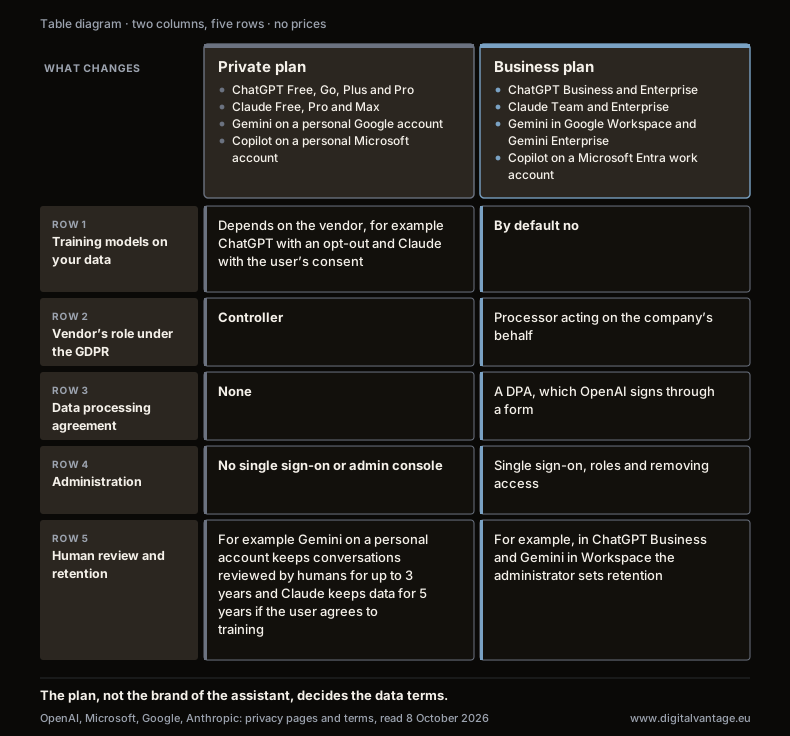
Private plan or business plan of an AI assistant: what changes
OpenAI, Microsoft, Google, Anthropic: privacy pages and terms, read 8 October 2026
Chart description
Two-column table-diagram, no prices. Private plan column: ChatGPT Free, Go, Plus and Pro; Claude Free, Pro and Max; Gemini on a personal Google account; Copilot on a personal Microsoft account. Business plan column: ChatGPT Business and Enterprise; Claude Team and Enterprise; Gemini in Google Workspace and Gemini Enterprise; Copilot on a Microsoft Entra work account. Row 1, training models on your data: private plans depend on the vendor, for example ChatGPT with an opt-out and Claude with the user's consent; business plans by default no. Row 2, the vendor's role under the GDPR: private plan, controller; business plan, processor acting on the company's behalf. Row 3, data processing agreement: private plan none; business plan a DPA, which OpenAI signs through a form. Row 4, administration: private plan no single sign-on or admin console; business plan single sign-on, roles and removing access. Row 5, human review and retention: for example Gemini on a personal account keeps conversations reviewed by humans for up to 3 years and Claude keeps data for 5 years if the user agrees to training; in business plans, for example ChatGPT Business and Gemini in Workspace, the administrator sets retention.
Training the models. On services for individuals such as ChatGPT, OpenAI states: "we may use your content to train our models" (policy of 13 March 2026). You can opt out in the privacy portal, but the opt-out covers only new conversations, and chats in Temporary Chat are not used for training. For business users the same page says: "By default, we do not train on any inputs or outputs from our products for business users, including ChatGPT Team, ChatGPT Enterprise, and the API."
Role under the GDPR. For a private user in the European Economic Area or Switzerland, OpenAI's EU privacy policy says that OpenAI Ireland Limited "is the controller": it decides how conversations are processed. On a business plan, once you sign the Data Processing Addendum, OpenAI "acts as a Data Processor on the Customer's behalf". For customers in an EEA country or Switzerland the contracting party is OpenAI Ireland, and transfers outside the EEA rest on standard contractual clauses or a European Commission adequacy decision under Art. 45 GDPR. On ChatGPT Business the agreement does not arrive by itself: OpenAI's Enterprise Privacy page (updated 8 January 2026) says the DPA is signed by filling in a DPA form.
Administration. ChatGPT Business has SAML single sign-on, an admin console, admin roles and domain verification, and OpenAI's pricing table marks each of these as unavailable on individual plans. Administrators control how long data is kept, and deleted or unsaved conversations are removed from OpenAI's systems within 30 days unless the law or the protection of its services requires longer retention.
Other vendors divide things the same way:
- Claude (Free, Pro, Max). According to Anthropic's announcement of 28 August 2025, the company trains new models on data from these accounts when the setting is on, and then keeps data for five years; without that consent the existing 30-day retention applies. The changes do not apply to Team and Enterprise, which run on commercial terms.
- Gemini on a personal Google account. Human reviewers read some conversations. Google's Gemini Apps Privacy Hub (updated 24 September 2026) says: "Please don't enter confidential information that you wouldn't want a reviewer to see or Google to use to improve our services," and that reviewed chats "are not deleted when you delete your activity" but kept for up to three years.
- Copilot on a personal Microsoft account. Use is governed by the Microsoft Services Agreement and the Copilot Terms of Use, not by the data processing addendum Microsoft concludes with organisations.
The business plans of all four vendors do not train their models on company data by default. Each says so in its own words, and some attach a condition:
- ChatGPT Business and Enterprise. OpenAI: "By default, we do not use your business data for training our models," unless you explicitly opt in to share data, for example through its feedback tools.
- Copilot Chat and Microsoft 365 Copilot on a work account. Microsoft's enterprise data protection documentation: "the prompts, responses, and data accessed through Microsoft Graph aren't used to train foundation models." The condition is a Microsoft Entra work account. Web queries to Bing have their own data handling, according to the same documentation.
- Gemini in Google Workspace. Google's generative AI privacy hub for Workspace: "Workspace does not use customer data for training models without customer's prior permission or instruction." The condition is a qualifying Workspace edition and no such permission.
- Gemini Enterprise. Google's Gemini Enterprise FAQ, on the Business, Standard and Plus editions: your data, "including prompts, outputs, and training," isn't used to train Google models or models for any other customer. The page attaches no condition.
- Claude Team and Enterprise. Anthropic's Commercial Terms: "Anthropic may not train models on Customer Content from Services." The Team pricing page is more cautious: no model training on your content "by default."
A paid private plan, meaning ChatGPT Plus or Pro or Claude Pro or Max, is therefore not a business plan. You pay for higher limits, and the data terms stay consumer terms.
What you already have in your suite: Copilot Chat and Gemini in Workspace
If your company runs on Microsoft 365 or Google Workspace, you probably already have an assistant on business terms. Before you buy another subscription, check what is switched on and under which rules.
Microsoft 365. According to Microsoft's documentation, Copilot Chat is available "at no extra cost for eligible users who sign in with a Microsoft Entra work or school account and have a qualifying Microsoft 365 subscription." The qualifying list includes Business Basic, Business Standard and Business Premium. Microsoft says that organisations' use of Copilot and Copilot Chat is covered by its Data Protection Addendum and Product Terms, with Microsoft acting as a data processor. Copilot Chat has limited reach: without a Microsoft 365 Copilot licence it has no access to your company's data in Microsoft Graph, meaning mail, files and chats. An employee can still upload a file into the conversation. Plan prices and the scope of AI in each plan are compared in Google Workspace or Microsoft 365.
Google Workspace. Gemini in qualifying Workspace editions follows the rules of the generative AI privacy hub (updated 14 August 2026). Prompts are customer data under the Cloud Data Processing Addendum, Google's processing agreement. Content is not human reviewed or used for model training outside your domain without permission. Prompts and responses in Gemini in Workspace are stored from 90 days to indefinitely, as set by the administrator. The scope depends on the plan: Business Starter has Gemini in Gmail and in the Gemini app, and Docs, Sheets and Meet follow only from Business Standard.
An assistant in your suite sees everything the employee is allowed to see. Microsoft says Copilot shows organisational data the user has at least view permission to, and Google says Gemini does not reach content the user cannot access. So folders shared too widely become a problem the day the assistant is switched on. We describe that hidden cost in the hub AI in business.
If you have Microsoft 365 or Workspace, start with the assistant that is already in the price: tidy up permissions and write the rules down. Buy a separate plan only when you know what that assistant lacks.
ChatGPT Business, Team and Enterprise: price and terms
ChatGPT Business costs €21 per user per month billed annually and €26 billed monthly, with a minimum of two seats. That is what OpenAI's pricing page shows for the EU (read 8 October 2026, identical for Ireland, Germany and France). The page does not say whether the amounts are net or gross. Monthly billing is about 24% dearer than annual (26 / 21, our calculation).
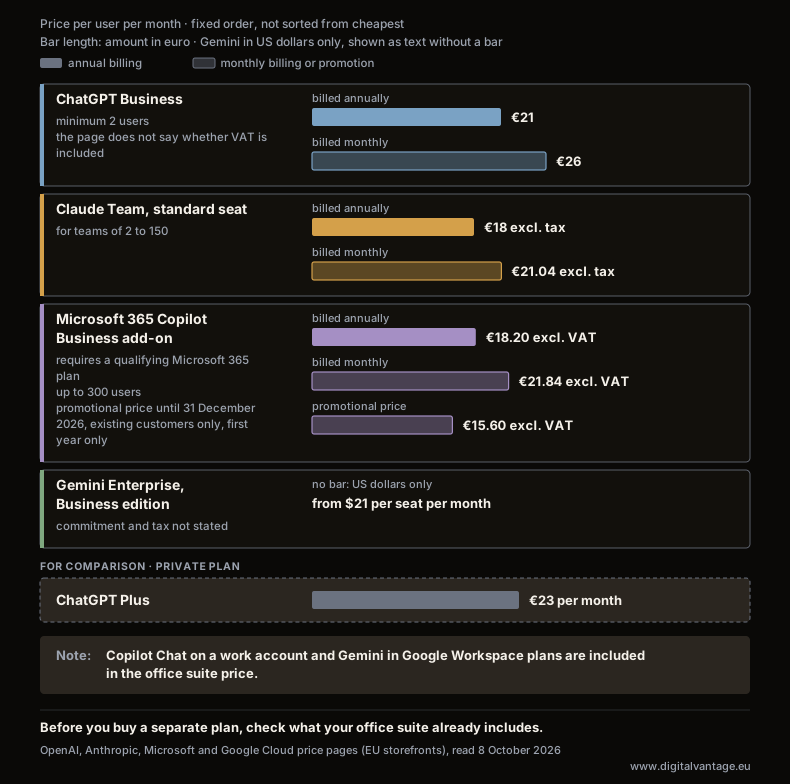
AI assistant for business: price per user per month and conditions, in EUR
OpenAI, Anthropic, Microsoft and Google Cloud price pages (EU storefronts), read 8 October 2026
Chart description
Horizontal bar chart, price per user per month in euro for ChatGPT, Claude and Copilot, in a fixed order, not sorted from cheapest. ChatGPT Business: €21 billed annually, €26 billed monthly; minimum 2 users; the page does not say whether VAT is included. Claude Team, standard seat: €18 billed annually, €21.04 billed monthly, prices shown exclude applicable tax; for teams of 2 to 150. Microsoft 365 Copilot Business add-on: €18.20 per user per month paid yearly, €21.84 on a monthly subscription, excluding VAT; requires a qualifying Microsoft 365 plan; up to 300 users; promotional price €15.60 until 31 December 2026, existing customers only, first year only. For comparison, the private plan ChatGPT Plus: €23 per month. Gemini Enterprise, Business edition: from $21 per seat per month, in US dollars only and shown without a bar; commitment and tax are not stated. Note: Copilot Chat on a work account and Gemini in Google Workspace plans are included in the office suite price.
ChatGPT Team is now ChatGPT Business. OpenAI renamed the plan on 29 August 2025 and existing Team workspaces became Business workspaces. According to OpenAI's help centre, the rename did not change the plan, though later prices and seat types may change. If you are looking for the price of "ChatGPT Team", the Business price applies.
Terms worth knowing before you buy:
- Minimum of two seats. A Business workspace needs at least two paid seats, standard or Premium. A Premium seat gives five times more usage than a standard seat and costs $100 per user per month billed annually or $125 billed monthly. Those are dollar prices from the help centre; the pricing page does not show the Premium seat price in euros.
- Payment and invoices. You pay for Business by credit card. Invoice billing, purchase orders or bank transfer are offered by OpenAI only through a sales-led contract, not self-serve Business. In the workspace billing settings you can add a Tax ID or VAT ID, and a change applies to future invoices only.
- Refunds and seat changes. Unused seats do not by themselves qualify for a refund once the workspace has committed to the seat count for a billing cycle. A seat reduction takes effect at the start of the next billing cycle.
- API separate. A Business subscription does not include API usage, which OpenAI bills separately.
- History and export. According to OpenAI's help, each user in a Business workspace has their own chat history, and data export is not available from a Business workspace.
Business also has workspace agents, company knowledge and connectors to tools such as Microsoft 365, Google Drive or Slack. The word "agent" in a feature name does not mean you are buying an autonomous agent; how an agent differs from an assistant is explained in AI agents in business.
ChatGPT Enterprise is priced individually by the sales team. Compared with Business it adds SCIM for automatic account provisioning, enterprise key management, role-based access control, an IP allowlist, compliance logs and ISO certifications 27001, 27017, 27018 and 27701, plus invoice billing and volume discounts. The most important difference for European companies is data residency: OpenAI announced data residency in Europe for ChatGPT Enterprise, ChatGPT Edu and the API Platform, and writes of "new" and "eligible" customers. The Business plan is not on that list. Whether your workspace qualifies is settled in the offer.
ChatGPT price: Plus or Business
Private ChatGPT Plus costs €23 a month, more than the €21 of one Business seat, but Business needs two seats. A one-person company would therefore pay at least €42 a month for Business billed annually (2 × €21, our calculation) against €23 for Plus.
The other private plans on OpenAI's EU pricing page (read 8 October 2026): Free €0, Go €8.50 and Pro from €103 a month.
The difference in terms matters more than the price. On Plus, as on other private plans, OpenAI may train its models on your conversations until you opt out in the settings. There is no single sign-on, admin console or roles, and OpenAI Ireland is a controller rather than a processor acting for your company.
A sensible split follows: use a business plan for company and client data, and keep the private plan for private tasks. If your staff already work on private Plus accounts, you are already paying for an assistant, only on terms that do not fit company data.
Copilot price for business: when to pay extra for Microsoft 365 Copilot
The Microsoft 365 Copilot Business add-on costs €18.20 per user per month with an annual commitment, excluding VAT. Microsoft's EU page (read 8 October 2026) adds: "Price does not include VAT." From 1 July to 31 December 2026 a promotional price of €15.60 applies, only to existing Microsoft 365 customers with an eligible business plan, only for the first year, and with an annual commitment. To buy the add-on you need a separate licence for a qualifying Microsoft 365 plan, and the offer covers up to 300 users. Paid monthly, as a monthly subscription, the add-on costs €21.84 per user per month, also excluding VAT.
Free Copilot Chat is not the same as paid Microsoft 365 Copilot. Copilot Chat, included with qualifying Microsoft 365 plans on a work account, runs in the browser, in the Microsoft Edge side panel, in Outlook and Teams, and in the Microsoft Copilot app. Microsoft describes it as a service with enterprise data protection, but without a Microsoft 365 Copilot licence it does not reach your mail and files. The paid add-on brings Copilot into Word, Excel, PowerPoint, Outlook and Teams and gives it access to company data through Microsoft Graph.
Names change. In the documentation Microsoft 365 Copilot is now called Microsoft Copilot, and Microsoft 365 Copilot Chat is called Microsoft Copilot Chat, although licences may still use the old names. In the store the add-on is still called "Microsoft 365 Copilot Business". Before that there was Bing Chat Enterprise: in November 2023 Microsoft announced that it was becoming Copilot, with commercial data protection for users signed in with an Entra account.
Microsoft also sells Business Standard and Business Premium with Copilot bundled. The prices of those bundles and the "bundle or add-on" calculation are in Google Workspace or Microsoft 365. For large organisations, Microsoft shows a separate price for Microsoft 365 Copilot (enterprise): €26.00 per user per month paid yearly or €27.30 paid monthly, both with an annual commitment and excluding VAT.
Where the data goes. "For EU customers, Microsoft Copilot is an EU Data Boundary service," says Microsoft's documentation (updated 8 October 2026), with one exception: models provided by Anthropic as a subprocessor are currently excluded from the EU Data Boundary, and that "as an admin, you can decide whether to use these models," with additional terms possibly applying. If data has to stay in the EU, the administrator should check that setting rather than leave it undecided.
Gemini for business: Gemini in Workspace or Gemini Enterprise
Gemini for business is now two different products: Gemini in Google Workspace plans, and a separate Gemini Enterprise subscription. If you have Workspace, Gemini is already in your plan, to a scope that depends on the edition. We do not give Workspace prices here; standard prices and the scope of AI in each plan are in Google Workspace or Microsoft 365.
"Gemini Business" was the name of a Workspace add-on that Google sold separately before it built Gemini into the plans in 2025. Under that label there are therefore two things: the former add-on, and today's Business edition of Gemini Enterprise.
Gemini Enterprise is a separate Google Cloud subscription, independent of the office suite. The Business edition page (read 8 October 2026) says: "Starting at $21 per seat per month," in US dollars only, with a 30-day trial. Google's FAQ describes the Business edition as "Great for individuals, small businesses, and teams up to 300", while the documentation table lists 1 to 500 seats, so we state no seat cap. The page does not say whether the "starting at" price needs an annual commitment, whether it includes tax, or what the minimum number of seats is. Google also lists Standard and Plus editions for larger organisations; we could not find a current price page for them, so we quote no price.
On data location, Google's Gemini Enterprise locations page (updated 7 October 2026; it covers the Standard, Plus, pay-as-you-go and Frontline editions, not Business) lists the eu and us multi-regions as supporting data residency at rest. For Workspace itself, administrators can choose the United States or the European Union as the data region for supported editions, but not on Business Starter; whether that choice covers Gemini prompts and responses is not confirmed.
Gemini Enterprise makes the most sense where company data lives in several systems, not only in Workspace. The private Gemini app on an ordinary Google account is a third case: it runs on consumer terms, with the human review of conversations described above.
Claude Team and Enterprise
Claude Team costs €18 per standard seat per month billed annually and €21.04 billed monthly, excluding tax, for teams of 2 to 150 people. Anthropic's pricing page (read 8 October 2026, EU storefront) states that prices shown don't include applicable tax. A Premium seat, with five times the usage limit, costs €90 billed annually and €105.23 billed monthly. Team has central billing and administration, single sign-on, a Microsoft 365 connector and enterprise search.
Claude Enterprise has no fixed price per person. It is US$20 per seat per month billed annually plus usage at API rates, which depends on the model and the task, and Anthropic shows this in US dollars in every market. Enterprise adds SCIM, audit logs, custom data retention controls and an IP allowlist. The cost therefore grows with the intensity of use, not only with the number of people.
The legal terms of Team and Enterprise come from Anthropic's Commercial Terms. For a customer in the EEA, Switzerland or the UK the contracting party is Anthropic Ireland, Limited. The Data Processing Addendum is incorporated into those terms, so you do not sign it separately; the customer is the controller and Anthropic the processor, and transfers outside the EEA rest on standard contractual clauses.
A disclosure: Digital Vantage uses Anthropic and OpenAI models through their APIs. Claude is in this comparison because for companies outside the Microsoft and Google ecosystems it is a real option with a published price, not because we favour it.
When a separate subscription makes sense and when the suite is enough
A separate assistant makes sense when your office suite does not cover the data your team works on, or when the company has no suite at all. The framework below is our proposal, and each condition rests on what the vendors write about their plans:
- You work in Microsoft 365 and the assistant should read the company's mail and files. Copilot Chat does not do that without a Microsoft 365 Copilot licence, so you need the add-on or a plan that includes Copilot.
- You have Google Workspace from Business Standard. Gemini in Docs, Sheets and Meet is already in the price. First check whether that is enough.
- You use several systems at once or have no office suite. Then a separate subscription is in play: ChatGPT Business, Claude Team or Gemini Enterprise.
- Data must stay in the EU. ChatGPT Business does not list this. OpenAI offers data residency in Europe for ChatGPT Enterprise, and Google lists EU residency for Gemini Enterprise Standard and Plus in its documentation. For EU customers, Copilot runs in the EU Data Boundary unless the administrator enables Anthropic models.
- You are a one-person company. ChatGPT Business and Claude Team need at least two seats. For one person the first step is usually the assistant in your office suite, if you use one.
- The team is large and few people use AI. You pay per seat, not per use, and on ChatGPT Business an unused seat does not by itself qualify for a refund. Buy licences for people who really work with the assistant.
Which model writes better in your language or summarises documents better, test on your own tasks before you sign an annual commitment.
Rules for employees: data, accounts and the AI Act
A business plan achieves nothing if employees keep pasting client data into private accounts. Buying the assistant and writing the rules down is one decision.
Processing agreement. When an employee enters personal data into an assistant on the company's behalf, the vendor processes it on behalf of the company as controller. GDPR Art. 28(1) then requires the controller to use only processors "providing sufficient guarantees to implement appropriate technical and organisational measures," and Art. 28(3) requires a contract that binds the processor. How you conclude that agreement with each of the four vendors is described above; on ChatGPT Business you must request it through a form. Questions to put to a cloud vendor before you buy are in cloud data security.
A private account is the problem. On a private account the company has no agreement with the vendor and no influence over the settings, and, as shown above, consumer terms allow training or human review. The European Data Protection Board's ChatGPT Taskforce report adds that the data accuracy principle applies even though a model can make things up.
A person checks the result. The EDPB report notes that users may take made-up output as fact. An assistant's answer is a draft, and the person who sends it answers for it.
AI Act. A company whose employees use an assistant at work is a "deployer" of an AI system under Art. 3(4) of the AI Act, unless the use is personal and non-professional. Art. 4, as amended in July 2026, requires deployers to take measures to support AI literacy among their staff. It does not require any particular level, and the European Commission explains that there is no duty to measure employees' knowledge. What else the AI Act demands of a deployer and how penalties work is in the EU AI Act for your company; the hub AI in business collects the calendar. Authorities and penalty rules are set per member state.
Rules we suggest you write down before switching the assistant on (our list, not a legal requirement):
- Company accounts only. For company and client data staff use only accounts on a business plan, signed in through the company identity.
- What may be entered. Decide in writing what may be pasted into the assistant and what may not, for example special-category data or information under confidentiality agreements.
- Only the connectors you need. Switch off connections to mail, drives and other systems the team does not need.
- Permissions before the start. Tidy up access to folders and sites.
- Verification before sending. A person checks every result that goes to a client or into a document. A model can state falsehoods with confidence.
- Removing access. When someone leaves, you switch off their account in one place, through single sign-on.
Accounts, two-factor login and where company data really lives are covered in protecting company data. If your company works in a profession bound by secrecy, such as law, medicine or banking, settle the requirements for AI tools with a lawyer or data protection officer.
FAQ
Frequently asked questions about ChatGPT, Copilot and Gemini for business
Plus is a private plan at €23 a month; Business is a business plan at €21 per user per month billed annually or €26 billed monthly, from two users (OpenAI's EU pricing page, read 8 October 2026; the page does not say whether VAT is included). On Plus OpenAI may train its models on your conversations until you opt out, and it is the data controller. On Business OpenAI by default does not train on company data, signs a data processing agreement once you fill in the DPA form, and the company gets single sign-on, an admin console and roles.
Yes. OpenAI renamed ChatGPT Team to ChatGPT Business on 29 August 2025, and existing Team workspaces became Business workspaces. According to OpenAI the rename itself did not change the plan. The Business price applies today: €21 per user per month billed annually, €26 billed monthly.
It can, but it will pay for two seats, because a Business workspace needs at least two. Billed annually that is €42 a month (2 × €21, our calculation). Claude Team also starts at two people. If you use Microsoft 365 or Google Workspace, first check the assistant in your suite: Copilot Chat on a work account, or Gemini in a Workspace plan.
On a Microsoft Entra work account, Copilot Chat runs on business terms: organisations' use is covered by Microsoft's Data Protection Addendum, Microsoft is the processor, and prompts and responses are not used to train foundation models. On a personal Microsoft account the Microsoft Services Agreement applies instead of a processing agreement. Without a Microsoft 365 Copilot licence, Copilot Chat has no access to company mail and files; an employee can upload a file by hand.
OpenAI's data residency in Europe is announced for ChatGPT Enterprise, ChatGPT Edu and the API Platform for new and eligible customers, and the Business plan is not on that list, so we do not say that Business stores data in the EU. For customers in an EEA country or Switzerland the contracting party is OpenAI Ireland, and transfers outside the EEA rest on standard contractual clauses or a European Commission adequacy decision.
If employees enter personal data into the assistant on the company's behalf, GDPR Art. 28 requires a contract with the processor. Each vendor does it differently: OpenAI on ChatGPT Business through a DPA form, Microsoft through its Data Protection Addendum and Product Terms, Google through the Cloud Data Processing Addendum, and Anthropic in Commercial Terms into which the DPA is incorporated. Private accounts give no such contract. If in doubt whether a use requires one, ask a lawyer or data protection officer.
Already have an assistant in your suite and unsure whether to buy a second?
We will go through the data your team enters into AI with you and check whether what you have is enough, or whether you need a business plan or an integration through an API.
Related Posts
- AI in business — where to start, what it costs and what the law says
AI in business without the hype: how many EU firms use it, when an assistant is enough and when you need an agent, what it costs and what the AI Act requires.
- 1.EU AI Act for business — duties, deadlines and fines after the 2026 changes
EU AI Act for business: what you must do if you use AI, when the rules apply after the July 2026 amendment, who enforces them and what fines can reach.
- 2.AI agent in business — what it is and when it makes sense
An AI agent is a system where a language model chooses its own steps and tools. When an agent makes sense in a business, what it costs and what the AI Act says.
- 1.
About the Team
Digital Vantage Team
Your Partner in Business, Digital Vantage Team
Digital Vantage team is a group of experienced professionals combining expertise in web development, software engineering, DevOps, UX/UI design and digital marketing. Together we carry out projects from concept to implementation - websites, e-commerce stores, dedicated applications and digital strategies. Our team combines years of experience from technology corporations with the flexibility and immediacy of working in a smaller, close-knit structure. We work in agile methodologies, focus on transparent communication and treat each project as if it were our own business. The strength of the team is the diversity of perspectives - from systems architecture and infrastructure, frontend and design, to SEO and content marketing strategy. As a result, the client receives a cohesive solution where technology, aesthetics and business goals go hand in hand.