Marketing on the InternetSEO and Website OptimizationAnalytics ToolsTechnology for businessesCompanyUX/UI design13 min czas czytania18 022 znaki2500 słów
KPIs and goals for a website - How to measure success in online business [2026].
Learn more about Kpi I Goals. A practical guide with concrete tips and examples. Learn best practices and avoid common mistakes.
Redakcja Digital VantageYour Partner in Business, Digital Vantage Team · Digital Vantage team is a group of experienced professionals combining expertise in web development, software engineering, DevOps, UX/UI design and digital marketing. Together we carry out projects from concept to implementation - websites, e-commerce stores, dedicated applications and digital strategies.
Our team combines years of experience from technology corporations with the flexibility and immediacy of working in a smaller, close-knit structure. We work in agile methodologies, focus on transparent communication and treat each project as if it were our own business.
The strength of the team is the diversity of perspectives - from systems architecture and infrastructure, frontend and design, to SEO and content marketing strategy. As a result, the client receives a cohesive solution where technology, aesthetics and business goals go hand in hand.
Publikacja
Aktualizacja
What do you find in the article?
- SMART framework for digital goals - It's a practical approach that makes it easy to convert general business objectives into specific online goals. This allows you to set measurable indicators of success and better track your progress.
- Dedicated KPIs for different industries - We have prepared ready-made sets of metrics for different types of companies. For service companies we have cost per lead, for e-commerce we have conversion rate, and for B2B marketing qualified leads. There is something for every industry.
- Google Analytics 4 configuration - We'll show you step-by-step how to set up key events for tracking. You'll also learn how to choose the attribution model that best fits your business.
- Behavioral tools beyond GA - You'll learn about tools like Hotjar and Clarity that will help you understand why users are abandoning forms and where you're losing potential customers. This can be the key to increasing conversions.
- Data-driven optimization cycle - Introduce the proven process Measure → Analyze → Optimize → Repeat. By prioritizing activities according to ROI and presenting a case study of your company's 6-month transformation, you will find it easier to implement effective changes.
Introduction - Why KPIs are the foundation of online success
Many companies treat their websites merely as business cards - static elements that "just have to exist." Meanwhile, the key difference between businesses that thrive online and those that struggle to stay afloat often comes down to one skill: measuring and optimizing results.
Imagine running a blindfolded business. You don't know how many customers visit your store, how many of them ask about your products, or whether your promotions actually work. Absurd, right? Yet this is how most businesses operate online.
The statistics speak for themselves: as many as 87% of small and medium-sized businesses have no goals set in Google Analytics. They operate on the principle of "I have a page, so customers will be found." It's like shooting blindly and counting on luck.
The difference between "I have a page" anda strategic approach to online presence is colossal. The first group spends money on a redesign every two years because "something doesn't work." The second group systematicallyincreases the number of customers, because it knows exactly which elements of the site generate inquiries and which inhibit sales.
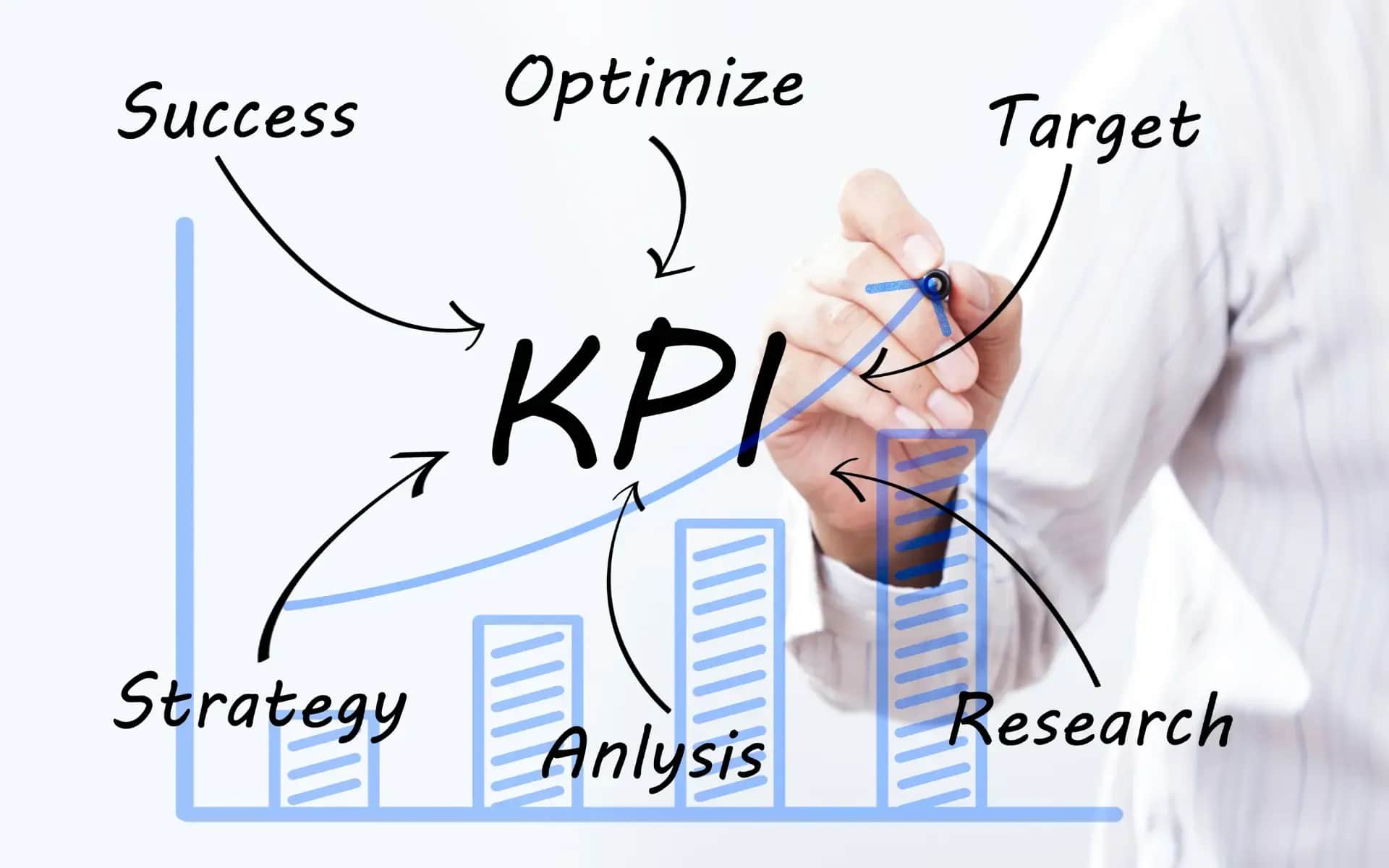
KPIs (Key Performance Indicators) are not boring numbers for analysts. They are a compass that indicates whether yourThe site makes money, or just generates costs. It's the difference between conjecture and knowledge.
In this article you will get a concrete framework for defining business goals and translating them into measurable indicators. You will learn practical tools that will reveal the truth about your site - sometimes painful, but always valuable.
We will discuss not only Google Analytics 4, but also additional measurement tools to discover your customers' behavior. I will show you how to build an optimization process based on data, not assumptions.
Anatomy of successful online business goals
Without a clear goal structure, every click on a page can seem random. Often companies make a basic mistake - they start with details, such as the color of the button, instead of a broad strategy. It's worthwhile to first determine where the button should lead the customer.
Hierarchy of goals - from vision to metrics
Successful online targets resemble the layout of Russian matryoshkas, where each target fits into a larger one, forming a coherent structure.
At the very top are strategic goals - these are long-term visions for the company's development. For example, "to become a leader in serving manufacturing companies in the region" is a strategic goal that extends over 2-3 years and sets the direction for all activities.
Then we have operational goals - these are specific, measurable tasks for the coming quarters. For example, "acquire 50 new B2B customers by the end of the year" is an operational goal that is easy to count, with a deadline and clear criteria for success.
The SMART model is particularly relevant in digital operations. The goal "to increase website traffic by 30% in 6 months" meets these criteria: it is specific (30%), measurable (using analytics), achievable (depending on the starting point), relevant (if traffic translates into customers) and time-bound (6 months).
The key element is to combine business goals with the technical capabilities of the site. If you want to sell premium services, your site should build trust through case studies and testimonials. Business goals should dictate functionality, not the other way around.
A real-life example: a consulting firm wants to acquire 20 new clients per quarter. The strategic goal translates into an operational goal: 100 qualified leads per month (assuming 20% conversion from lead to client). This means you need 500 lead magnet downloads (at 20% form conversion). Now you know what to measure.
The most common mistakes in defining goals
"We want more customers". - I often hear this from new customers. But it's more of a wish than a goal. More compared to what? How much growth do you expect? Over what period of time? From what target group? Without specifics, you won't build an effective measurement strategy.
Another mistake is to focus on traffic alone. "We get 10,000 visits a month!" - says the entrepreneur proudly. I ask, "How much of that is potential customers?" Suddenly there is silence. Traffic without conversions is like a crowd of people in front of a closed store.
Many also omit the customer journey from their plans. They assume that a customer will visit the site and immediately make a purchase. And yet, on average, it takes 7-8 points of contact before someone decides to do business with you. Aiming for "direct sales from the site" in B2B is often a recipe for disappointment.
Too often, goals are set without regard to measurement capabilities. For example, you define a goal of "improving the quality of leads," but have no idea how to measure that quality. The result? You operate in the dark for months.
Types of KPIs for different types of business
Each business requires a customized approach to measuring success. What works for an online store may not make sense for a consulting firm. The key to success is to tailor your metrics to your specific industry and sales model.
KPIs for service companies
In the service industry, everything revolves around leads - potential customers who are interested in doing business with you. Important metrics include the number of contact forms, phone calls and emails received by the site.
Contact forms are key to conversion in B2B services. It is worth monitoring not only their number, but also the traffic sources that generate the most valuable leads. We often find that a blog attracts more valuable inquiries than a homepage.
Phone calls are another important channel. With Google Analytics and call tracking, it is possible to see which sites drive people to call. In industries such as legal and medical, up to 60-70% of conversions are done over the phone.
The quality of leads is often more important than their quantity. Lead scoring allows you to assess the value of each inquiry. A customer who asks "How much does a website cost?" has a different value than one who details his project and budget.
Cost per lead (CPL) is a metric that links marketing to finance. If you spend £500 a month on a promotion and get 10 leads, the CPL is £50. Compare that to the value of the customer over time - if the average contract is £5,000, you have a healthy ratio of 1:100.
KPIs for e-commerce
Conversion rate is a key indicator in e-commerce. The average in Poland is 1.5-3%, but the differences between industries are significant. Electronics converts at 1%, while cosmetics can reach 5-7%.
Conversion optimization is an ongoing process. Test everything from product images to descriptions and the payment process. Changing one button can increase sales by 20%.
Average Order Value (AOV) shows how much customers spend in one go. Cross-selling and up-selling can increase AOV by 30-50%. Offer complementary products during order finalization.
Repeat Purchase Rate measures customer loyalty. A new customer costs 5-7 times more than keeping an existing one. If 30% of customers return, you are on the right track.
Abandonment rates are a wake-up call. 70% of shopping carts are abandoned - mainly by a complicated payment process or hidden costs. Cart abandonment emails can recover 15-20% of abandoned transactions.
KPIs for B2B companies
The long sales cycle requires patience in measurement. It can take 6-12 months from initial contact to contract signing. Track every step of the customer path.
Marketing Qualified Leads (MQLs) are those who have downloaded an e-book, attended a webinar, or repeatedly visited key pages. Sales Qualified Leads (SQL) are those who have demonstrated a willingness to have a sales conversation.
Cooperation between marketing and sales is key. Establish criteria together for transferring leads. Marketing generates the MQLs, and sales evaluates and converts them into SQL.
Content engagement in nurturing prospects is a long-term game. Time on page, scroll depth and returns to the blog show growing interest. LinkedIn or email marketing helps maintain contact through the long decision-making process.
Google Analytics 4 - your main measurement tool
Tracking various KPIs for business models is one thing, but without the right tool, it's like cooking in the dark. Google Analytics 4 is your analytics command center - as long as you know how to use it.
Configuration of targets in GA4
Google has completely changed its approach to tracking in GA4. Forget the traditional "Goals" - we're now operating on "Events" and "Conversions." This is not just a cosmetic change, it's a whole new way of thinking about measurement.
In the old Analytics, clicking the "Contact" button was the goal. In GA4, it is an event that you can mark as a conversion. What does this change? Flexibility. You can track every user action as an event, and then decide which ones are conversions.
The most important events for businesses are: filling out a form, clicking a phone number, downloading a PDF and viewing a key page, such as a price list. In e-commerce, we additionally track adding to a shopping cart, starting payment and finalizing a purchase.
Attribution models in GA4 determine which marketing channels get credit for conversions. Data-driven attribution is the new standard - Google uses machine learning to distribute credit across channels. If a customer first visited through Google Ads, then through social media and finally bought after email, each channel gets its share of success.
Dashboards and reporting
Checking analytics regularly, at least once a week, is a must for any business. Instead of sifting through dozens of reports, set up automatic summaries. GA4 can send you weekly emails with key metrics.
Key metrics to monitor are: number of conversions, top traffic sources, bounce rate for key pages and user paths. You don't need 50 metrics - just 5-7 that directly impact your business goals.
Red flags that require an immediate response are a sudden drop in conversions of more than 20%, a bounce rate increase of more than 80% on key pages, and errors in e-commerce tracking. Set up alerts in GA4 - it's better to get a false alarm than to miss a real problem.
Personalized dashboards in Looker Studio (formerly Data Studio) allow you to combine data from GA4 with other tools. One screen, all key metrics, automatic refresh. It's the difference between chaos and complete control over your data.
Additional measurement tools beyond Google
Google Analytics is a staple, but to really know your users, you need deeper insights. GA4 shows you "what" is happening on your site, but doesn't explain "why." This is where behavioral tools come in.
Hotjar and Microsoft Clarity - understanding user behavior
Heatmaps act like an x-ray of your site. They show exactly where users are clicking, how far they are scrolling and which elements are being skipped. Microsoft Clarity is free, while Hotjar offers more options for a small fee.
Session recordings are videos of actual user sessions. Watching someone struggle with your form for a few minutes can be painful, but it's priceless. It allows you to spot problems that analytics won't detect.
The most common problems discovered? Users try to click on items that are not links, miss key buttons by the wrong colors, and give up when filling out a form by having too many fields.
Hotjar's analysis of forms shows which field users are most likely to give up on. The "Company TIN" field on a contact form can deter 40% of potential customers. Sometimes one checkbox "I agree to a 15-minute call" discourages more people than the entire rest of the form.
A/B testing tools
Testing only makes sense with sufficient traffic. If you have less than 1,000 visitors per month, forget about A/B testing - it will take years to achieve statistical significance.
Microsoft Clarity includes built-in testing options, and Google Optimize closed in 2023. Alternatives include Optimizely or VWO, but for most companies, testing one item at a time without specialized tools is enough.
Statistical significance of 95% is the minimum. Usually this means 2-4 weeks of testing, depending on the movement. Ending the test too early is the most common mistake.
Which tests have the greatest impact? The home page headline, the text of the main CTA button, and the first section of the landing page. Changing "Contact Us" to "Check Price List" can double conversions.
Data-driven optimization process
Data without action is like a map without a compass - helpful in theory, but in practice it won't do much. The real value of analytics is revealed when the numbers are transformed into concrete changes on the page.
Cycle: Measure → Analyze → Optimize → Repeat
The frequency of analysis depends on the type of metric. Conversions are worth checking weekly. Google positions - monthly. Algorithm changes or seasonal fluctuations can distort short-term data.
Prioritizing optimization is the art of selecting the most promising opportunities. Start with the easiest-to-implement changes that can yield significant benefits. Optimizing a contact form takes about 2 hours of work. Redesigning the entire site requires as little as 2 months. Which option will bring a better return on investment?
You'll find the best chances of success in three areas: pages with high traffic and low conversions, processes with high abandonment rates (e.g., forms, shopping carts), and traffic sources with high quality but low participation.
A practical example: the client had 1,000 visits to the price list page and 2% conversion. Changing one headline increased the conversion to 3.5%. That's 15 additional leads per month thanks to one change.
Case study: 6-month transformation
A training company was struggling: high traffic, but few inquiries. They had 5,000 visitors a month, but only 8-12 leads.
We started with a data audit. Google Analytics showed that 60% of the traffic was going to a blog that had no call-to-action. People were reading articles and leaving.
After three months: we added lead magnets to articles, optimized the contact form and created a landing page for key services.
Results after 6 months: same traffic, but 45-50 leads per month. 300% increase. Cost of changes: PLN 3,000. Value of additional customers: PLN 80,000 per year.
What have we learned? The simplest changes often have the greatest effect. Avoid changing everything at once - this makes it difficult to assess what really works.
Building a data-driven culture in the company
Convincing your team about metrics starts with showing the benefits, not the responsibilities. Instead of saying "we need to track the data," it's better to say "with this data we will know what works."
For small teams, simple processes are sufficient. A weekly 15-minute review of key metrics, one person responsible for the data, clear success criteria for each project.
The balance between analysis and action is a challenge for any company. Analysis-paralysis is a real threat. Set limits: maximum 20% of time for analysis, 80% for action.
A practice proven in many projects is the 80/20 rule. Make 80% of your decisions based on simple data from GA4. 20% of more challenging projects analyze deeper with additional tools.
Summary and action plan
In today's digital world, measuring success online is not a luxury, but an absolute necessity. What separates companies that are growing rapidly online from those that are struggling? A key element is the ability to precisely define goals and systematically analyze them.
What are the most important conclusions? First - the goal should be clearly defined and measurable. Instead of saying "we want more customers," it's better to put it at "getting 50 new leads per month." Second - it is important that KPIs are tailored to the specifics of your business. Online stores should pay attention to conversion, while B2B companies should focus on the quality of leads acquired. Third - make decisions based on data, not intuition.
The first step should be to review your current situation. Check what data you are already collecting (or if you are measuring anything at all). Set up Google Analytics 4, establishing basic goals. Also consider implementing tools for tracking calls and acquiring leads.
Sample template for defining goals:
- Business goal (e.g., getting 30 new customers per quarter)
- Operational goal (150 leads per month with 20% conversion rate)
- Site metrics (500 e-book downloads with 30% conversion)
- Measurement tool (GA4 + Hotjar)
- Frequency of inspection (once a week)
Need support setting up a metering system for your business?Make an appointment for a free strategy consultation. We will take a look at your current site and help you identify areas where you may be losing potential customers.
What's next?
If you plan to implement in the next 2-3 months:
First steps:
- Define your KPIs - Set specific goals that you want to achieve with your website using the SMART framework.
- Configure Google Analytics 4 - Make sure you have correctly configured events to track key activities on the site.
- Choose behavioral tools - Consider using Hotjar or Clarity to analyze user behavior and identify points where you are losing potential customers.
Useful tools:
- Google Analytics 4 - for tracking and analyzing site traffic.
- Hotjar/Clarity - to understand how users interact with your site.
Do you need help?
- Make an appointment for a free consultation - We will discuss your case and help you plan your implementation
If you are still gathering knowledge:
Recommended articles:
- Guide - Learn how to effectively plan an online strategy
- Why It's Worth It - Understand why a strategic approach to online presence is key
⚠️Important
KPIs and Goals are the foundation of effective online marketing. Poorly defined goals can lead to wasted resources and a lack of clear direction. Invest time up front to avoid costly mistakes in the future.
About the Team
Digital Vantage Team
Your Partner in Business, Digital Vantage Team
Digital Vantage team is a group of experienced professionals combining expertise in web development, software engineering, DevOps, UX/UI design and digital marketing. Together we carry out projects from concept to implementation - websites, e-commerce stores, dedicated applications and digital strategies. Our team combines years of experience from technology corporations with the flexibility and immediacy of working in a smaller, close-knit structure. We work in agile methodologies, focus on transparent communication and treat each project as if it were our own business. The strength of the team is the diversity of perspectives - from systems architecture and infrastructure, frontend and design, to SEO and content marketing strategy. As a result, the client receives a cohesive solution where technology, aesthetics and business goals go hand in hand.